


Hello, grade 12s. These notes will guide you through your momentum and impulse topic.
Have you ever ever wondered why you don't feel the mosquito's landing on your skin but you feel it when water droplets land/splash on your skin? Well, this will be understood better with the principle of momentum that we will learn about in this article.
Scope
- Introduction to momentum
- Change in momentum
- Newton's second law of motion and momentum
- Conservation of momentum
- Impulse
- Impulse and safety
1. Introduction to momentum
We opened the article with the example of a mosquito landing on your skin and water droplets splashing you. We all agree that we never feel a mosquito landing on our skin- we only feel their presence after being bitten.
So why do we not feel the landing of a mosquito but feel the splash of water? Well, the answer is simply, momentum.
Now let us consider a case of two objects: a brick and a tennis ball. Which one, if thrown at you would hurt you the most? It is the brick, right? So why? Is it because it is heavier? Possibly! So what if we slow the speed at which the brick is thrown? It would still hurt the most, right?
Welcome to momentum! As seen with the case above, we see that there is a property that explains collisions.
Momentum is defined as the product of the mass of an object and its velocity. The formula:
$${\normalsize p=mv}$$Momentum is a vector quantity and as with all vector calculations state a direction which is positive for your claculations. It has SI units of \(kg\cdot{m} \cdot{s}^{-1}\)
Example: A 450g soccer ball leavres the foot of a footballer at a velocity of 25m/s. Calculate the ball's momentum.
Answer: \(\normalsize m=450g=0.45kg\) and \(\normalsize v=25m/s, forward\)
Forward direction is positive
$$ \normalsize \begin{align*} p&=mv&\\ & =(0.45)(25)\\ & =11,25 \textrm{ }kg\cdot{m} \cdot{s}^{-1} \textrm{, forward} \end{align*} $$Notice the final answer has the momentum units and a direction, forward. This because momentum is a vector quantity.
2. Change in momentum
Whenever objects collide, they change their velocity. They either slow down or speed up. Think about what happens when a ball bounces off a wall or breaks through a window. The ball's velocity will change. Refer to the diagram below.
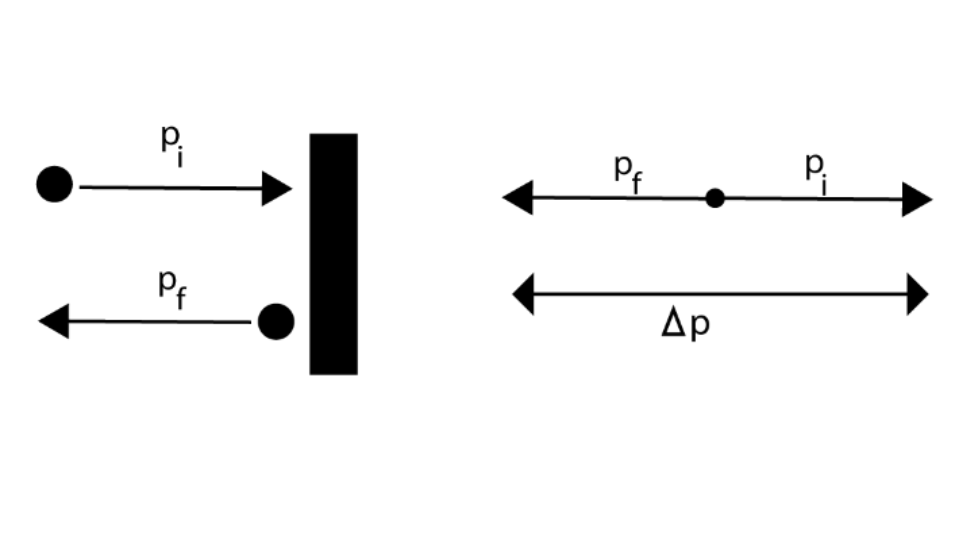
The ball strikes the wall with initial velocity, \(\normalsize v_i\), and bounces off with final velocity, \(\normalsize v_f\). This causes the ball's momentum to change.
In section 1, we mentioned that momentum is a vector quantity. The right hand side of Fig.1 shows vector addition of momentum. The change in momentum is therefore defined as:
$$ \normalsize \begin{align*} \Delta{p}=p_f-p_i \textrm{ , or}\\ \Delta{p}=mv_f-mv_i \end{align*} $$3. Newton's second law of motion and momentum
In section 2, we saw that momentum of an object can change. According to Sir Isaac Newton, an object will remain at rest or move at a constant velocity unless acted upon by a net force.
We can therefore say that this net force is the reason behind the change in momentum. Now that the net force is acting on our object, we expect the object to accelerate, this, changes the velocity of the object. Isn't this his second law of motion? Yes it is.
The mathematical definition of Newton's second law of motion is:
$${\normalsize F_{net}=ma}$$Do you remember that acceleration is the rate of change of velocity? Let's revisit that definition.
$$ \normalsize \begin{align*} F_{net}&=ma\\ F_{net}&=m \left( \frac{\Delta{v}}{\Delta{t}} \right)\\ F_{net}&=m \left( \frac{v_f-v_i}{\Delta{t}} \right)\\ F_{net}&=\left( \frac{mv_f-mv_i}{\Delta{t}} \right)\\ F_{net}&=\left( \frac{p_f-p_i}{\Delta{t}} \right)\\ F_{net}&=\left( \frac{\Delta{p}}{\Delta{t}} \right)\\ \end{align*} $$From this derivation we see that Newton's second law of motion in terms of momentum states that:
The net force acting on an object is rate of change of momentum.
The mathematical definition:
$${\normalsize F_{net}=\frac{\Delta{p}}{\Delta{t}} }$$Example: A striker shot a 450g soccer ball at a velocity of 25m/s towards a goalkeeper, who on reaction, paved the ball away with a velocity of 16m/s. If the contact between the goalkeeper's gloves and the ball lasted for 0.01s, calculate force experienced by the ball during this contact.
Forward direction is positive
$$ \normalsize \begin{align*} F_{net} &=\frac{\Delta{p}}{\Delta{t}}\\ &=\frac{mv_f-mv_i}{\Delta{t}}\\ &=\frac{(0.45)(-16)-(0.45)(25)}{0.01}\\ &=-1845\\ &=1845 \textrm{ }kg\cdot{m} \cdot{s}^{-1}\textrm{, backwards} \end{align*} $$4. Conservation of momentum
We will now look at when two objects collide with each other. Let us say, for example, two billiard balls colliding with each other, Fig 2.
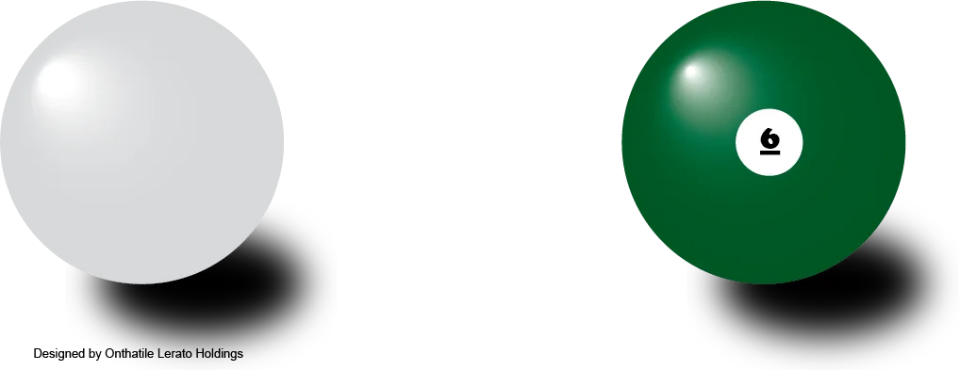
To simplify our case, we will deal with an isolated system, which is a system in which net force is zero.
Another definition of an isolated system is that it is a physical configuration of objects/particles that we study that does not exchange any matter with its surroundings and is not subject to any force whose source is external to the system (Ref: Everythig science).
In the case of the billiard balls, we will assume there is no other force that influences the motion of the objets. This simply means that the system is isolated.
By applying Newton's 3rd law of motion, the net force experienced by each ball is:
$${\normalsize F_A=-F_B}$$The forces above are the net forces which can be defined as, \(\normalsize F_{net}=ma\). This is Newton's 2nd law of motion, which in terms of momentum, can be defined as:
$${\normalsize F_{net}=\frac{\Delta{p}}{\Delta{t}}}$$We can now quantify collision of the two balls, mathematically.
$$ \normalsize \begin{alignat}{1} F_A &=-F_B\\ \frac{\Delta{p_A}}{\Delta{t}} &=-\frac{\Delta{p_B}}{\Delta{t}}\\ \Delta{p_A} &=-\Delta{p_B}\\ \Delta{p_A}+\Delta{p_B}&=0 \end{alignat} $$From this derivation, we see that if you add the change in momentum of all particles involved in the collision, their total will be equal to zero.
Now we have arrived at the principle of conservation of linear momentum. The principle states:
In an isolated system, total linear momentum is conserved/constant.
What this means, as is the case for all "conservation principles" you will encounter in science, is that, total momentum before collision equals total momentum after collision.
Mathematically, we represent this principle as:
$$ \normalsize \begin{align*} \Delta{p_A}+\Delta{p_B}&=0\textrm{ , or}\\ p_{T_i} &= p_{T_f} \end{align*} $$where \(\normalsize p_{T_i}\) is the total momentum before collision and \(\normalsize p_{T_f}\) is the total momentum after collison.
The total momentum, \(\normalsize p_{T}\) can be calculated as:
$${\normalsize p_T=p_{1}+p_{2}+p_{3}+...}$$The 1; 2; 3, ... , represent the objects with 1 being object 1, 2 being object 2, 3 being object 3, etc.
For grade 12, we look at the momentum of two objects only.
Example: Two billiard balls, each of mass 168g collide with each other. A white ball moving at 2m/s strikes the green ball which is at rest(Fig. 2 above). Calculate the velocity of the green ball after the collision if the white ball moved back at 0.78m/s.
Rightwards is positive
$$ \normalsize \begin{align*} p_{T_i} &= p_{T_f}\\ m_{A}v_{Ai}+m_{B}v_{Bi} &= m_{A}v_{Af}+m_{B}v_{Bf}\\ 0.168(2)+0.168(0) &= 0.168(-0.78)+0.168v\\ 0.336 &= 0.131404+0.168v\\ 0.20496 &= 0.168v\\ v &= 1.22\textrm{ m/s, rightwards} \end{align*} $$A note to take from the conservation of momentum is that, in a colision, objects experience the same amount of forces but in opposite direction. This is application of Newton's 3rd law.
Elastic and inelastic collisions.
Collisions are either elastic or inelastic. In an isolated system,total momentum is always conserved.
To check if a collision is elastic or inelastic, check if total kinetic energy before collision is equal to total kinetic after collisions.
Elastic collision is a collision in which both total momentum and the total kinetic energy are conserved.
Mathematically;
$${\normalsize E_{ki} = E_{kf}}$$Example: Two billiard balls, each of mass 168g collide with each other. A white ball moving at 2m/s strikes the green ball which is at rest(Fig. 2 above). After the collision, the white ball moved back at 0.78 m/s while the green ball moved to the right at 1.22 m/s.
If collision is elastic
$$ \normalsize \begin{align*} E_{ki} &= E_{kf}\\ E_{ki}&=\frac{1}{2}m_{A}v_{Ai}^{2}+\frac{1}{2}m_{B}v_{Bi}^{2}\\ &=\frac{1}{2}(0,168)(2)^{2}+\frac{1}{2}(0,168)(0)^{2}\\ &=0,34J \end{align*} $$Now, let's calculate the kinetic after collision.
$$ \normalsize \begin{align*} E_{ki}&=\frac{1}{2}m_{A}v_{Af}^{2}+\frac{1}{2}m_{B}v_{Bf}^{2}\\ &=\frac{1}{2}(0,168)(-0,78)^{2}+\frac{1}{2}(0,168)(1,22)^2\\ &=0,18J \end{align*} $$5. Impulse
Remember, when a net force acts on an object, the object will accelerate. A larger net force will cause a large net force.
In section 3, we derived Newton's second law in terms of momentum, \( \normalsize F_{net}=\frac{\Delta{p}}{\Delta{t}}\).
Impulse is the product of the net force and the time interval durig which the force acts.
Mathematically, this is defined as:
$$ \normalsize \begin{align*} Impulse &= F_{net}\Delta{t}\text{ or}\\ \Delta{p} &= F_{net}\Delta{t} \end{align*} $$This equation tells us that impulse is the change in momentum.It has the S.I. units of momentum. We can also use \(\normalsize N\cdot{s}\)
Example: A baseball player swings his bat and hits a baseball, exerting 12 000N on the ball for 0.0077s. Calculate the impulse provided for the ball.
Answer: \(\normalsize F_{net}=12 000N\) towards the ball and \(\normalsize \Delta{t}=0.007s\). Based on Newton's 3rd law of motion, the bat applies the force that is equal and in opposite that of the ball.
Towards the bat is positive
$$ \normalsize \begin{align*} \Delta{p} &= F_{net}\Delta{t}\\ &= -12000\times 0.007\\ &= -84 \text{ N}\cdot{s}\\ &= 84 \text{ N}\cdot{s}, \text{ away from the bat}\\ \end{align*} $$6. Impulse and safety.
Impulse is applied to improve safety and reduce injuries. We make use of the equation, \( F_{net}= \frac{\Delta{p}}{\Delta{t}}\).
The essence of the application of impulse to safety is to reduce the force of impact, thereby causing less damage. This is done by increasing the time of impact.
- Airbags in cars.
- Crumple zone in cars
- Safety belts in cars
- Arrestor beds
- Padding is keepers' gloves (goalkeeper's or wicketkeeper's)
- Padding in gymnastics' mats
- Follow-through in sports