


Contents
1. Introduction
In mathematics, we define number patterns as patterns which contain a list of numbers that follow each other in a certain order. The order can vary from linear, quadratic, cubic, geometric, etc.
The Oxford English Dictinary definition of patterns is that a pattern is the regular arrrangement of lines, shapes, colours, etc. This is no different to the mathematical definition given in line 1.
You have seen what are patterns. Now let us introduce number sequences. A sequence is an ordered list of numbers. Sequences have patterns. Let us look at them:
$$ \normalsize \begin{align*} & 1;2;3;4;5;...\\ & 7;11;15;19;23;...\\ & 1;4;9;15;24;...\\ & 5;10;20;40;80;... \end{align*} $$The above numbers are an example of sequences. The items on sequences are reffered to as terms. For example, for the first sequence, the 1 is the 1st term, 2 is the 2nd term, 3 is the 3rd term, and so on. The ellipsis (…) means that the sequence continues forever.
Generally, sequences are in the following form:
$${\normalsize T_1;T_2;T_3;T_3;T_4;T_5;\ldots}$$2. Types of sequences
We will look at three types of sequences: Linear/arithmetic sequences, quadratic sequences and geometric sequences.
Arithmetic sequences
Arithmetic sequences have a common difference. Each consecutive term is an addition of this common difference. They resemble a straight line graph, which has the form, \(\normalsize y=mx+c\).
Given the sequence:
$${\normalsize T_1;T_2;T_3;T_3;T_4;T_5;\ldots}$$Assuming the sequence is linear, the common difference, \(d\), is:
$${\normalsize d=T_2-T_1=T_3-T_2=T_4-T_3=\ldots}$$Because we have observed that the sequence is arithmetic, we can now determine its equation, which we call the general term, \(\normalsize T_n\).
$${\normalsize T_n=a+(n-1)d}$$Where \(T_n\) is the term value (alternatively called the general term or the \(n^{th}\) term), \(a\) is the first term of the sequence, \(n\) is the term number and \(d\) is the common difference.
NB: \(T_n\) will sometimes be referred to as the \(n^{th}\) term.
Let us try a few examples
- \(\normalsize 1;2;3;4;5;\ldots\)
- \(\normalsize 5;10;15;20;25;\ldots\)
- \(\normalsize 7;11;15;19;23;\dots\)
Solutions
\(\normalsize \text{ }1;2;3;4;5;\ldots\)
$$ \normalsize \begin{align*} a &=1 \text{ This is the first term}\\ d &=T_2-T_1\\ &=2-1\\ &=1 \end{align*} $$Therefore the general term is:
$$ \normalsize \begin{align*} T_n &=a+(n-1)d\\ &=1+(n-1)(1)\\ &=1+n-1\\ &=n \end{align*} $$\(\normalsize \text{ }5;10;15;20;25;\ldots\)
$$ \normalsize \begin{align*} a&=5\\ d&=T_2-T_1\\ &=10-5\\ &=5 \end{align*} $$Therefore the general term is:
$$ \normalsize \begin{align*} T_n&=a+(n-1)d\\ &=5+(n-1)(5)\\ &=5+5n-5\\ &=5n \end{align*} $$\(\text{ }7;11;15;19;23;\dots\)
$$ \normalsize \begin{align*} a&=7\\ d&=T_2-T_1\\ &=11-7\\ &=4 \end{align*} $$Therefore the general term is:
$$ \normalsize \begin{align*} T_n&=a+(n-1)d\\ &=7+(n-1)(4)\\ &=7+4n-4\\ &=4n+3 \end{align*} $$
The examples above have shown us how to determine the general term. Now let us try a different example.
The third term of an arithmetic sequence is 17 and the ninth term is 41. Determine the values of \(a\), \(d\) and the \(n^{th}\) term of this sequence.
Solutions
$${\normalsize T_n=a+(n-1)d}$$We are give the third term, \(T_3\), and the ninth term, \(T_9\) and their values. Now we must find the unknowns.
$$ \normalsize \begin{align} T_n&=a+(n-1)d\nonumber\\ T_3&=a+(3-1)d\nonumber\\ 17&=a+2d \tag{1} \end{align} $$Doing the same for the ninth term.
$$ \normalsize \begin{align} T_n&=a+(n-1)d\\ T_9&=a+(9-1)d\\ 41&=a+8d \tag{2} \end{align} $$Solve for \(a\) and \(d\) simultaneuously.
$$ \normalsize \begin{align} 17&=a+2d\tag{1}\\ 41&=a+8d \tag{2}\\ \text{(2)-(1): } 24&=6d \\ d&=4 \end{align} $$Substituting \(d\) onto \((1)\) or \((2)\), we get:
$${\normalsize a=9}$$The General term, \(\normalsize T_n\) can now be determined
$$ \normalsize \begin{align} T_n&=a+(n-1)d\\ T_n&=9+(n-1)(4)\\ T_n&=9+4n-4\\ T_n&=4n+5 \end{align} $$Quadratic sequences
Quadratic sequences have the form of a quadratic graph, \(\normalsize y=ax^2+bx+c\). However, they only take positive intergers. Thus, they have the general term:
$${\normalsize T_n=an^2+bn+c}$$The quadratic sequence, has a common second difference. Consider the Fig. 1:
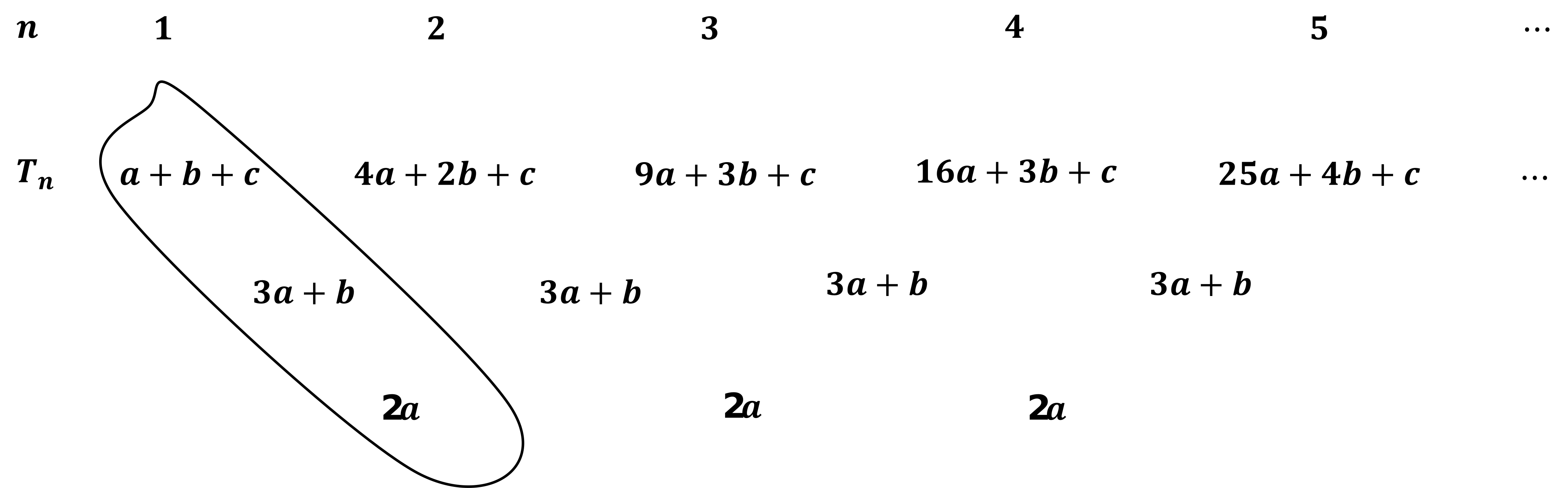 Fig. 1: Formula breakdwon of quadratic patterns.
The row of \(\normalsize T_n\) is obtained by substituting \(\normalsize n={1;2;3;4;\ldots}\) on \(\normalsize T_n=an^2+bn+c\). The third row is the differences of \(\normalsize T_n\) and \(\normalsize T_{n-1}\). This is to say, for example, is obtained by saying, \(\normalsize T_2-T_1\), \(\normalsize T_3-T_2\), etc. The last row is obtained the same way as the third row.
The first difference of a quadratic sequence yields a linear sequence. This prompts us to find the second difference which we can see from Fig. 1 that it is constant. When the second difference is constant, we can then conclude the sequence is quadratic.
When we need to determine the parameters, \(a\), \(b\) and \(c\), we need to compare the values we got in our sequence with the structure in Fig. 1. The comparison is the following:
$$ \normalsize \begin{align} T_1&=a+b+c\\ T_2-T_1&=3a+b\\ \text{Common }2^{nd}\text{ difference}&=2a \end{align} $$Now let us take a few examples to make sense of this.
Find the general term of the following:
- \(\normalsize 2;6;14;26;\dots\)
- \(\normalsize -1;0;3;8;\ldots\)
Solutions
\(\normalsize \text{i. } 2;6;14;25;\dots\)
$$ \normalsize \begin{align*} \text{ }2;6;14;26;\dots\\ 4;8;12;\dots\\ 2;2;\ldots \end{align*} $$We can see that \(\normalsize T_1=a+b+c\) corresponds to 2 on first row. \(T_2-T_1=3a+b\) corresponds to 4 on the second row and that the common second diference is 2, which is on the third row and equaivalent to \(2a\).
$$ \normalsize \begin{align} 2a&=4\\ a&=2\\ \\ 3a+b&=4\\ 3(2)+b&=4\\ 6+b&=4\\ b&=-2\\ \\ a+b+c=2\\ 2-2+c&=2\\ c&=2 \end{align} $$The general term:
$${\normalsize T_n=2n^2-2n+2}$$\(\normalsize \text{ii. }-1;0;3;8;\ldots\)
$$ \normalsize \begin{align*} -1;0;3;8;\ldots\\ \text{ }1;3;5;\dots\\ 2;2;\ldots \end{align*} $$Here we can see that \(\normalsize T_1=a+b+c=\) corresponds to \(\normalsize -1\), \(\normalsize T_2-T_1=3a+b\) corresponds to 1 and that the common second difference is is 2.
$$ \normalsize \begin{align} 2a&=2\\ a&=1\\ \\ 3a+b&=1\\ 3(1)+b&=1\\ 3+b&=1\\ b&=-2\\ \\ a+b+c=1\\ 1-2+c&=1\\ c&=0 \end{align} $$The general term:
$${\normalsize T_n=n^2-2n}$$NB:You may also apply your knowledge of quadratic graphs to solve problems of quadratic patterns. This is more prevalent in the exam.
Geometric sequences
$${\normalsize 2;6;18;54;\ldots}$$Look at the sequence above. Every term, except the first, is the previous term multiplied by 3. Sequences like these are called geometric sequences.
This 3 is referred to as the common ratio. which we find by: $${\normalsize \frac{6}{2}=\frac{18}{6}=\frac{54}{18}=3}$$
Let us now try to understand how we made this sequence.
\(\normalsize 2=2\times 3^0\)
\(\normalsize 6=2\times3^1\)
\(\normalsize 18=6\times3=2\times3\times3=2\times3^2\)
\(\normalsize 54=18\times3=2\times3\times3\times3=2\times3^3\)
We can see that for the second term and beyond, the sequence is made by multiplying the previous term with 3. This creates a pattern of 2 multiplied with base 3 powers. Therefore the general term is:
$${\normalsize T_n=2\times3^{n-1}}$$This 3 is the common ratio. The \(\normalsize n-1\) accounts for the fact that sequences are valid for \(\normalsize n \in\mathbb{N}\), so when \(\normalsize \mathbb{N}=1\), i.e., the first term, we see that the 3 is to the power zero.
Generally, the general term of a geometric sequences is:
$${\normalsize T_n=a{\cdot}r^{n-1}}$$Where:
\(\normalsize T_n\) is the general term or term value
\(\normalsize a\) is the first term.
\(\normalsize r\) is the common ratio
\(\normalsize n\) is the term number
To find \(\normalsize r\):
$${\normalsize r=\frac{T_2}{T_1}=\frac{T_3}{T_2}=\frac{T_4}{T_3}=\ldots}$$Now let us try some few examples.
Find the general term of the following:
- \(\normalsize 128;64;32;\ldots\)
- \(\normalsize 0,25;0,5;1;\ldots\)
Solutions
\(\normalsize \text{i. }128;64;32;\ldots\)
\(\normalsize a=128\)
\(\normalsize r=\frac{T_2}{T_1}=\frac{64}{128}=\frac{1}{2}=2^{-1}\)
The general term is:
$$ \normalsize \begin{align} T_n&=a{\cdot}r^{n-1}\\ &=128{\cdot}(2^{-1})^{n-1}\\ &=128{\cdot}2^{-n+1} \end{align} $$\(\normalsize \text{ii. }0,25;0,5;1;\ldots\)
\(\normalsize a=0,25\)
\(\normalsize r=\frac{T_2}{T_1}=\frac{0,5}{0,25}=2\)
The general term is:
$$ \normalsize \begin{align} T_n&=a{\cdot}r^{n-1}\\ &=0,25{\cdot}2^{n-1} \text{ or}\\ &=\frac{1}{4}{\cdot}2^{n-1}\text{ or}\\ &= 2^{n-3} \end{align} $$Now let us try one last example
Example: The second term of geometric term is 3, while the seventh is \(\normalsize 22\frac{25}{32}\). Calculate the \(a\), \(r\), and the general term of this sequence.
Solutions
$${\normalsize T_n=a{\cdot}r^{n-1}}$$\(\normalsize T_2=3\)
\(\normalsize T_7=22\frac{25}{32}=\frac{729}{32}\)
Dividing (2) with (1), we get:
$$ \normalsize \begin{align} \frac{729}{32\times3}&=\frac{ar^6}{ar^1}\\ \frac{243}{32}&=r^5\\ r&=\sqrt[5]{\frac{243}{32}}\\ r&=\frac{3}{2} \end{align} $$To get the value of \(\normalsize a\), we substitute the value of \(\normalsize r\) into either equation 1 or 2. Doing this , we get $${\normalsize a=2}$$
The general term of the sequence is:
$$ \normalsize \begin{align} T_n &=ar^{n-1}\\ &= 2\cdot (\frac{3}{2})^{n-1} \end{align} $$3. Sum of terms and sigma notation
We have looked at three types of sequences. Now let us take it a notch up and look at their sum. But first, let us begin with an introduction.
You are building a pattern of shapes using sticks and realised the shapes have the following sequence:
$${\normalsize 1;4;7;10;13;17\ldots}$$How many sticks would yoou need to build these your patterns? Say a pattern of six shapes?
To do this, you will have to add the sticks for all six shapes. That is:
$${\normalsize 1+4+7+10+13+17}$$The sum for all six is 53.
Calculate the sum of the following:
- \(\normalsize 3+4+5+6\)
The answer is \(18\) - \(\normalsize 1+4+9+16+25\)
The answer is 55 - \(\normalsize 1+2+4+8+16\)
The answer is \(31\)
Imagine if we were to add 50 numbers. They would fill this page or you would stop the task because you got bored along the way. Mathematics helps us from being bored from having to manually count these by introducing a compact way of writing sums.
Sigma notation
We use the sigma notation to write a sum of numbers in a short form.
Remember that to write the sum of all 50 or 100 terms would be tedious. Now let us explore this sigma notation.
Say we are given this sum: \(\normalsize 15+30+35+40+\ldots\) up to 50 terms. We would stop the calculation or run to EXCEL, right? Yes.
We will write the sum of terms as \(S_n\), where \(n\) is the term number. The sigma notation is written as:
$${\normalsize S_n=\sum_{n=1}^{m}T_n}$$where:
\(\normalsize n=1\) is the start index
\(\normalsize m\) is the end index and
\(\normalsize T_n\) is your general term
The start index tells you where you should start calculating, and the end index tells where you should end your calculation.
Let's try some examples
Write the following in sigma notation:
- \(\normalsize 1+2+3+4+\ldots\) up to 20 terms
- \(\normalsize 25+30+35+40+45+50+55\)
- \(\normalsize 40+80+160+320\)
- \(\normalsize 3+3+3+3+3+3\)
Solutions
\(\normalsize \text{i. }1+2+3+4+\ldots\)
This looks like an arithmetic sequence.
- Its general term is \(\normalsize T_n=n\)
- \(\normalsize T_1=1\) so start index is \(\normalsize n=1\)
- We are told "up to 20 terms". So the end index is 20.
- Counting from 1 to 20, we have 20 terms, therefore \(\normalsize S_n=S_20\).
The sigma notation is:
$${\normalsize S_{20}=\sum_{n=1}^{20}n}$$\(\normalsize \text{ii. }25+30+35+40+45+50+55\)
- General term: \(\normalsize T_n=5n+20\)
- Start index is 1
- There are six terms, so we will say end index is 7
- \(\normalsize S_n=S_7\). There are 7 terms $${\normalsize S_7=\sum_{n=1}^{6}5n+20}$$
It can also be written as:
$${\normalsize S_7=\sum_{n=5}^{11}5n}$$This considers that the pattern is a multiple of 5 and start counting at \(\normalsize n=5\) and ends at 11.
\(\normalsize \text{iii. }40+80+160+320\)
- This is a geometric sequence. \(a=40\)
- \(\normalsize r=\frac{80}{40}=2\)
- The general term of this sum is \(\normalsize T_n=40\cdot 2^{n-1}\)
- There are 4 terms. $${\normalsize S_4=\sum_{n=1}^{4}40\cdot2^{n-1}}$$
Alternatively,
$${\normalsize S_4=\sum_{n=1}^{4}5\cdot2^{n+2}}$$\(\normalsize \text{iv. } 3+3+3+3+3+3\)
This is a sum of constant terms. There is no general solution. Therefore the sigma notion is:
$${\normalsize S_6=\sum_{n=1}^{6}3}$$To know number of terms when given a sigma notation, use the following:
$${\normalsize \text{Number of terms}=End -\text{ Start}+1}$$Write the first four terms of the sum, and the number of terms of the following:
- \(\normalsize \sum_{n=1}^{5}2n\)
- \(\normalsize \sum_{n=3}^{7}2an\)
- \(\normalsize \sum_{n=3}^{12}6\)
- \(\normalsize \sum_{n=1}^{b}n^2\)
Solutions
\(\normalsize \text{i. } \sum_{n=1}^{5}2n\)
The first four terms:
$$ \normalsize \begin{align} &=2(1)+2(2)+2(3)+2(4)\\ &=2+4+6+8 \end{align} $$The number of terms:
$$ \normalsize \begin{align} \text{Number of terms}&=End -\text{ Start}+1\\ &=5-1+1\\ &=5 \end{align} $$\(\normalsize \text{ii. } \sum_{n=3}^{7}2an\)
The first four terms:
$$ \normalsize \begin{align} &=2a(3)+2a(4)+2a(5)+2a(6)\\ &=6a+8a+10a+12a \end{align} $$The number of terms:
$$ \normalsize \begin{align} \text{Number of terms}&=End -\text{ Start}+1\\ &=7-3+1\\ &=5 \end{align} $$\(\normalsize \text{iii. }\sum_{n=3}^{12}6\)
The first four terms:$${\normalsize =6+6+6+6}$$
The number of terms:
$$ \normalsize \begin{align} \text{Number of terms}&=End -\text{ Start}+1\\ &=12-3+1\\ &=10 \end{align} $$\(\normalsize \text{iv. }\sum_{n=1}^{b}n^2\)
The first four terms:
$$ \normalsize \begin{align} &=1^2+2^2+3^2+4^2\\ &=1+4+9+16 \end{align} $$The numberof terms:
$$ \normalsize \begin{align} \text{Number of terms}&=End -\text{ Start}+1\\ &=b-1+1\\ &=b \end{align} $$With this number of terms, we say the series has b-th terms
4. Series
We have seen how to write sum of numbers. Now we will introduce a way of calculating the sum of numbers.
A series is a sum of terms of a sequence. Mathematically, we represent a series as:
$${\normalsize S_n=T_1+T_2+T_3+T_4+\ldots}$$In grade 12, we look at finite arithmetic series, finite geometric series and the infinite series.
Finite arithmetic series
To calculate the sum of terms of an arithmetic sequence, you use the following equations:
$$ \normalsize \begin{align} \normalsize S_n&=\frac{n}{2}(a+l)\tag{1}\\ \normalsize S_n&=\frac{n}{2}[2a+(n-1)d]\tag{2} \end{align} $$where:
\(\normalsize S_n\) is the sum of terms
\(\normalsize n\) is the term number
\(\normalsize a\) is the first term
\(\normalsize l\) is the last term of the sequence/series
\(\normalsize d\) is the common first difference.
If you are given the first terms and other successive terms, use (1). If given the first and the last term, use (2).
Now let us try a few examples to understand these formulas.
ExampleS: Determine the sum of the first 25 terms:
- \(\normalsize 1+2+3+4\ldots\)
- \(\normalsize -8-5-2+1+\ldots\)
- \(\normalsize 22+17+12+7+\ldots\)
Solutions
\(\normalsize \text{i. }1+2+3+4\ldots\)
\(\normalsize a=1\)
\(\normalsize d=T_2-T_1=2-1=1\)
\(\normalsize n=25\)
\(\normalsize S_{25}=?\)
\(\normalsize \text{ii. } -8-5-2+1+\ldots\)
\(\normalsize a=-8\)
\(\normalsize d=T_2-T_1=-5-(-8)=3\)
\(n=25\)
\(\normalsize S_{25}=?\)
\(\normalsize \text{iii. }22+17+12+7+\ldots\)
\(\normalsize a=-8\)
\(\normalsize d=T_2-T_1=17-22=-5\)
\(n=25\)
\(\normalsize S_{25}=?\)
Now we will try a different example that requires some algebra.
Example: sum of the first 16 terms of an arithmetic sequence is 528. Determine the first term and the common first difference if the seventh term is 21.
Solutions
\(\normalsize S_{16}=528\)
\(\normalsize T_7=27\)
\(\normalsize a=?\)
\(\normalsize d=?\)
Solving for \(\normalsize a\) and \(\normalsize d\) simultaneously, we get:
$${\normalsize a=3 \text{ and }d=4}$$Finite geometric series
Turning our attention to the sum of terms of the geometric sequence, the sum of terms can be calculated as:
$$ \normalsize \begin{align} S_n=\frac{a(r^n-1)}{r-1}\text{, }r\gt1\tag{3}\\ S_n=\frac{a(1-r^n)}{1-r}\text{, }r\lt1\tag{4} \end{align} $$The use of equations (3) and (4) depend on the value of r, If \(\normalsize r\gt1\), we use (3) and if \(\normalsize r\lt1\), we use (4).
Now let us try a few examples
Find the sum of the first 12 terms:
- \(\normalsize 1+3+9+27\ldots\)
- \(\normalsize 9+3+1+\frac{1}{3}+\ldots\)
- \(\normalsize 120+60+30+15+\ldots\)
Solutions
\(\normalsize \text{i. }1+3+9+27\ldots\)
\(\normalsize a=1\)
\(\normalsize d=\frac{T_2}{T_1}=\frac{3}{1}=3\)
\(n=12\)
\(\normalsize S_{12}=?\)
\(\normalsize \text{ii. }9+3+1+\frac{1}{3}+\ldots\)
\(\normalsize a=9\)
\(\normalsize d=\frac{T_2}{T_1}=\frac{3}{9}=\frac{1}{3}\)
\(n=12\)
\(\normalsize S_{12}=?\)
\(\normalsize \text{iii. }120+60+30+15+\ldots\)
\(\normalsize a=120\)
\(\normalsize d=\frac{T_2}{T_1}=\frac{60}{120}=\frac{1}{2}\)
\(n=12\)
\(\normalsize S_{12}=?\)
Infinite series
Consider what would happen if we sum the following:
\(\normalsize 1+2+3+4+\ldots\)
\(\normalsize 5+10+20+40+\ldots\)
\(9+3+1+\frac{1}{3}+\ldots\)
The first two series will always return a value which is different per any value of \(\normalsize n\). the same cannoy be said about the last series. Series like the first two are termed, the finite series, while the third is termed the infinite series.
Series are classified as convergent or divergent.
- Divergent series
- are those that do not get closer to a certain number as the number of terms increase.
- Convergent series
- are those that get closer to a certain number as the number of terms increase.
NB: All arithmetic series are divergent, and not all geometric series are divergent.
For a geometric series to converge, \(\normalsize -1{\lt}r{\lt}1\). This means \(\normalsize r\) must be greater than \(\normalsize -1\) or less than 1.
Series that converge, sum up to infinity. The sum to infinity is:
$${\normalsize S_{\infty}=\frac{a}{1-r}}$$Find the sum to infinity:
- \(\normalsize \frac{1}{2}+\frac{1}{4}+\frac{1}{8}+\)
- \(\normalsize 9+3+1+\frac{1}{3}+\ldots\)
Solutions
\(\normalsize \text{i. }\frac{1}{2}+\frac{1}{4}+\frac{1}{8}+\ldots\)
First, let us check if this series converges.
\(\normalsize r=\frac{T_2}{T_1}=\frac{\frac{1}{4}}{\frac{1}{2}}=\frac{1}{2}\)
The series converges. Therefore, we can use sum to infinity.
\(\normalsize \text{i. }\normalsize 9+3+1+\frac{1}{3}+\ldots\)
First, let us check if this series converges.
\(\normalsize r=\frac{T_2}{T_1}=\frac{3}{9}=\frac{1}{3}\)
The series converges. Therefore, we can use sum to infinity.