


Introduction
In the lower grades, you learnt about energy and the different kinds of energy. You defined energy as:
- Energy:
- The ability to do work
You looked at different types of energy like light, heat, movement, sound, stored energy(in food, petrol, wood oil, etc.). In grade 10, you are going to learn about two kinds of energy: the kinetic the potential. You also learnt about them in grade 7 natural sciences but we are going to give them formulas.
You have also learnt that energy cannot be created or destroyed. This, we called the law of conservation of energy. We can also state it as:
- Law of conservation of energy:
- In an isolated system, total energy is conserved
This law explains why, for example, when an object is dropped on the surface, the surface it landed on will be a hot for a moment. This is because while the object was up in the air, it had a greater potential energy which decreases as the height decreases. So, the potential energy was transferred to kinetic energy and heat. Pause a bit or click here to read more on this
Kinetic energy, \(E_k\)
Kinetic energy is the energy that an object has due to its motion. This energy is therefore relation to motion, i.e., speed.
$${\normalsize E_k= \frac {1} {2} mv^2}$$The \(E_k\) represents the kinetic energy measured in Joules(J), \(m\) is the mass of the object in kilogram(\(m)\) and v is the speed.
Example: A 41 kg girl is running on a track. Calculate her kinetic energy if she is running at 5 \(m\cdot s^{-1}\).
Solutions
Potential energy, \(E_p\)
The potential energy of an object is defined as the energy of an object due to it position on Earth relative to some reference point.
$${\normalsize E_p=mgh}$$The \(E_p\) is the potential energy of the object in Joules(\(J\)), \(m\) is the mass of the object in kilogram \((kg)\), \(g\) is the gravitational acceleration, 9.8 \(m\cdot s^-2\) and the \(h\) is the height in metres \((m)\).
Example: A 41 kg girl is jumping on the extreme sports trampoline. The photographer captured her when she was 15 \(m\) above the surface of the trampoline. Calculate her potential energy at this level.
Solutions
Mechanical energy
The mechanical energy of an object is the object's sum of the kinetic and the potential energies.
$${\normalsize E_m=E_k+E_p}$$Example: A 41 kg girl is jumping on the extreme sports trampoline. The photographer captured her when she was 15 \(m\) above the surface of the trampoline. The video records her moving at 4 \(m \cdot s^{-1}\). Calculate her mechanical energy at this level.
Solutions
The law of conservation of mechanical energy.
When the only forces acting on the object are the contact forces, e.g., gravity, mechanical energy is conserved.
In physical sciences, whenever you see the words, “law of conservation …”, always remember that total of the property is the same at different times. Let us begin the law of conservation of mechanical energy by reminding you of the law of conservation of energy.
Energy cannot be created or destroyed but can only be converted from one form to another or transferred between systems. Another way of putting it, to make it consistent with what we said above:
- The law of conservation of mechanical energy:
- In an isolated system, total mechanical energy remains constant.
- Isolated system:
- A system in which the net force acting on the system is zero.
For mechanical energy to be conserved, the only force acting on the object should be the force of gravity.
So the law of conservation of mechanical energy suggests to us that if you look at the total energy at one particular time, it will be equal to the total energy at any other particular time. Remember what we said in the introduction?
Example: Tladi, a 56 kg boy is 8 m above the ground when he begins sliding on a frictionless ramp. What is his speed at the bottom of the ramp?
Solutions
From the above calculation, we can see that as the height decreases, potential energy decreases while the kinetic energy increases. This direectly tells you that energy is not created or destroyed but converted to other forms.
Let us now look at another scenario in Fig. 1. If the path ABC is frictionless, we can say that mechanical energy is conserved. This means that mechanical energy at A is the same as the mechanical energy at B and at C.
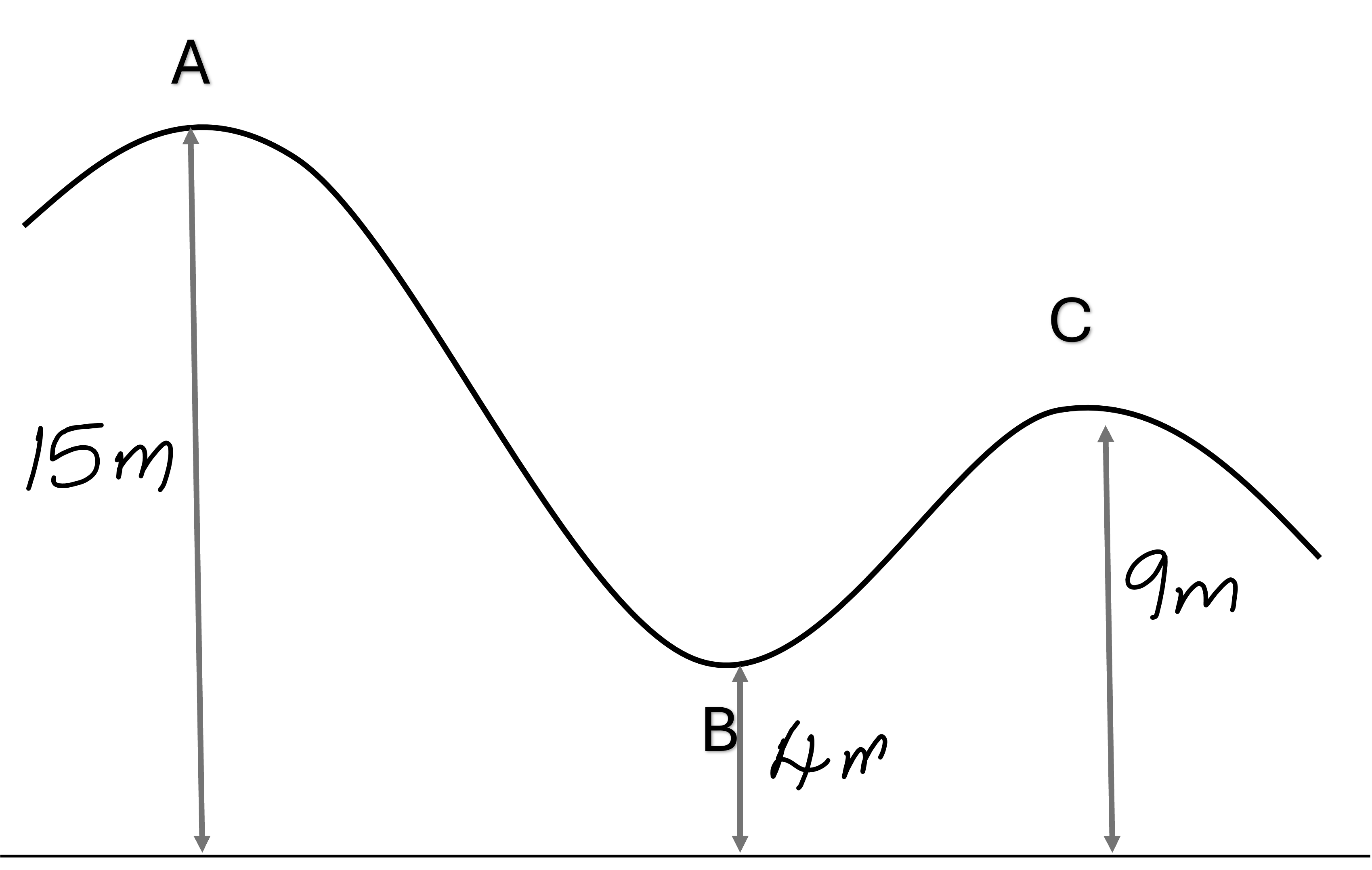
Example: Using Fig. 1. A 5 kg object at A moves from rest, passes through points B and C. If the surface is frictionless, prove that mechanical energy is conserved.
Solution
Calculating the speed at B:
$$ \normalsize \begin{align*} E_{m,B} &= E_{m, A}align\\ \frac{1}{2}mv_B^2+mgh_B &= \frac{1}{2}mv_A^2+mgh_A\\ \frac{1}{2}(5)v_B^2+(5)(9.8)(4) &= \frac{1}{2}(5)(0)^2+(5)(9.8)(15)\\ 2.5v_B^2+196 &= 0+735\\ 2.5v_B^2 &= 539\\ v_B^2 &= 215.6\\ v_B &= \sqrt{215.6}\\ v_B &= 14.6833\text{ m}\cdot s^{-1} \end{align*} $$Calculating the speed at C:
$$ \normalsize \begin{align*} E_{m,B} &= E_{m, A}\\ \frac{1}{2}mv_C^2+mgh_C &= \frac{1}{2}mv_A^2+mgh_A\\ \frac{1}{2}(5)v_C^2+(5)(9.8)(9) &= \frac{1}{2}(5)(0)^2+(5)(9.8)(15)\\ 2.5v_C^2+441 &= 0+735\\ 2.5v_C^2 &= 294\\ v_C^2 &= 117.6\\ v_C &= \sqrt{117.6}\\ v_C &= 10.8444\text{ m}\cdot s^{-1} \end{align*} $$Mechanical energy at the different points, A, B and C:
$$ \normalsize \begin{align*} E_{m,A} &= \frac {1} {2}mv_A^2+ mgh_A \\ &= \frac {1} {2}(5)(0)^2+ (5)(9.8)(15)\\ &= 735J \end{align*} $$ $$ \normalsize \begin{align*} E_{m,B} &= \frac {1} {2}mv_B^2+ mgh_B \\ &= \frac {1} {2}(5)(14.6833)^2+ (5)(9.8)(4)\\ &= 735J \end{align*} $$ $$ \normalsize \begin{align*} E_{m,C} &= \frac {1} {2}mv_C^2+ mgh_C \\ &= \frac {1} {2}(5)(10.8444)^2+ (5)(9.8)(9)\\ &= 735J\\ \end{align*} $$ $$ \normalsize \begin{align*} E_{m,A}=E_{m,B}=E_{m,C}align\\ \end{align*} $$Mechanical energy is conserved in the path
Path with a part frictionless and part with friction
Imagine an object moving along a path that is frictionless and later on, the pass experiences some friction. For such problem, you will have to use equations of motion to help you calculate the net force or the acceleration. The net force part is more prevalent for grade 11.

Example:Let’s look at Fig.2. We will say the 2kg block moves at 2 \(m \cdot s^{-1}\) at A and moves along a frictionless path AB, then comes to rest at C. Calculate the acceleration along BC if the path has a friction that will force the block to come to rest.
Solution
Mechanical energy on AB:
This path experiences no friction.
The acceleration required to stop the block at C:
Forward direction (B to C) is positive.