


Up to now, we know how to determine the roots by solving for the unknown, say \(x\) or by drawing a graph.
In your grade 11 maths syllabus, you are asked to find the nature of roots of some quadratic equation. NB: The following notes apply only for a quadratic equation.
$${\normalsize f(x)=ax^2+bx+c}$$To solve this question, you need to make use of a discriminant, ∆.
$$\Delta = b^2 -4ac$$Before you proceed to answer the question, make sure your equation is written in the form, \(\normalsize ax^2+bx+c=0\). Otherwise, do not use the discriminant. If your equation is a quadratic, then do the following:
- Find the values of \(a\), \(b\), and \(c\) of the quadratic and calculate the value of \(\Delta\).
- Now that you found the value of \(\Delta\). Note the following:
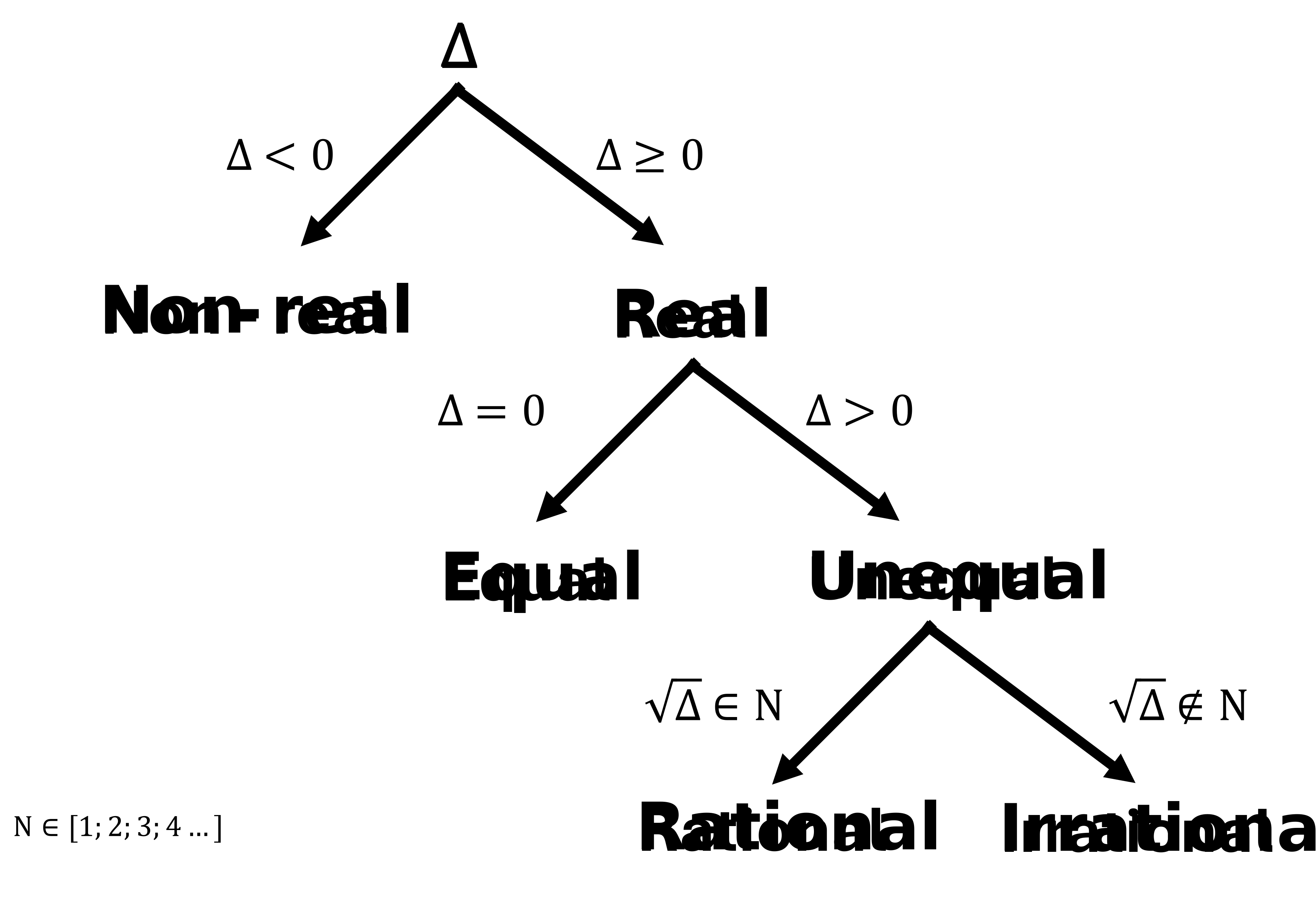
- If \(\Delta\) is a negative, the roots are non-real (imaginary).
- Otherwise, the roots are real (\(\Delta \ge 0\)).
- Now that the roots are real, look at their equality.
- If the \(\Delta\) is zero, the roots are equal.
- Otherwise, the roots are unequal (\Delta>0\).
- If they are unequal, check further if they are rational or irrational.
- If the \(\Delta\) is a perfect square, then the roots are rational.
- If not a perfect square, then the roots are irrational.
This information can be summarised in the figure below:
Additionally, pay attention to words like show that. When you are asked this, you must know that all coefficients of the quadratic expression will be given. You then need to substitute the values into your \(\Delta\) equation and find the nature of roots.
The question can also ask you to find values of some unknown parameter, e.g., some \(k\) or whatever parameter. To answer this, know the conditions listed above. In such a question, you will then need to proceed to solve the unknown parameter.
Now let us try a few examples to show you how to use this information.
Example: Determine the nature of roots of the following:
$$ \normalsize \begin{align*} &\text{i. }x^2-4x=-7\\ &\text{ii. }x^2+x-12=0 \end{align*} $$Solutions:
$$ \normalsize \begin{align*} &\text{i. }x^2-4x=-7\\ &x^2-4x+7=0\\ \\ &a=1;b=-4;c=7\\ \\ \Delta&=b^2-4ac\\ &=(-4)^2 -4(1)(7)\\ &=-12 \end{align*} $$By referring to Fig 1, the roots are non-real
$$ \normalsize \begin{align*} &\text{ii. }x^2+x-12=0\\ \\ &a=1;b=1;c=-12\\ \\ \Delta&=b^2-4ac\\ &=(1)^2 -4(1)(-12)\\ &=49 \end{align*} $$The square root of 49 is 7. This is a perfect square.
The roots are real, unequal and rational.
Example: The roots of a quadratic equation are given by\(\displaystyle x=\frac{-2\pm \sqrt{4-20k}}{2}\). Determine the value(s) ok \(\normalsize k\) for which the equation will have real roots.
Solution:
$${\normalsize x=\frac{-2\pm \sqrt{4-20k}}{2}}$$The discriminant, \(\normalsize \Delta\), is anything under the square root. So, \(\normalsize \Delta =4-20k\)
For the roots to be real, \(\normalsize \Delta \ge 0\)
$$ \normalsize \begin{align*} \Delta&\ge 0\\ 4-20k&\ge 0\\ -20k&\ge -4\\ k &\le \frac{1}{5}\\ \end{align*} $$Example: For which values of \(\normalsize m\) will the equation \(\normalsize 2x(x+1)+m=x\) have non-real roots?
Solution:
$${\normalsize 2x(x+1)+m=x}$$We will put this equation in standard form.
$$ \normalsize \begin{align*} &2x(x+1)+m=x\\ &2x^2+2x+m=x\\ &2x^2+x+m=0\\ \end{align*} $$From the above, we can see: \(\normalsize a=2, b=1\) and \(\normalsize c=m\).
To have non-real roots, \(\normalsize \Delta \lt 0\)
$$ \normalsize \begin{align*} \Delta&\lt 0\\ b^2-4ac &\lt 0\\ 1^2-4(2)(m) &\lt 0\\ 1-8m &\lt 0\\ -8m &\lt-1\\ m &\gt \frac{1}{8} \end{align*} $$