


The work, energy and power topic in your grade 12 final exam is a 14 - 17 marks question.
CLAIM: If you still struggle with this topic after reading this article, we will give you a 30% discount on our double deal package.
In today's post, we will be giving you tips to pass the work, energy and power question. Before we get into the work, let's define some words.
Contact forces: forces between objects which are touching each other.
Non-contact forces: forces which act on an objects without coming physically in contact with it.
Conservative force: force whose work done by or against it depends only on the starting and ending points of the motion and not the path taken.
Non-conservative force: force for which work done on the object depends on the path taken by the object.
Mechanical energy, ME: the sum of the kinetic energy and the potential energy of the object
The four most important equations used in this topic:
$$ \displaystyle \begin{align*} ME_{\text{initial}}&=ME_{\text{final}} \tag{1}\\ W &=F\Delta{x}cos\Theta \tag{2}\\ W_{\text{net}}&=\Delta E_k \tag{3}\\ W_{NC}&=\Delta E_k+\Delta E_p \tag{4} \end{align*} $$Before attempting to answer the energy principles questions, it is important that you draw a free-body diagram of the problem you are given.
Usage of equation 1
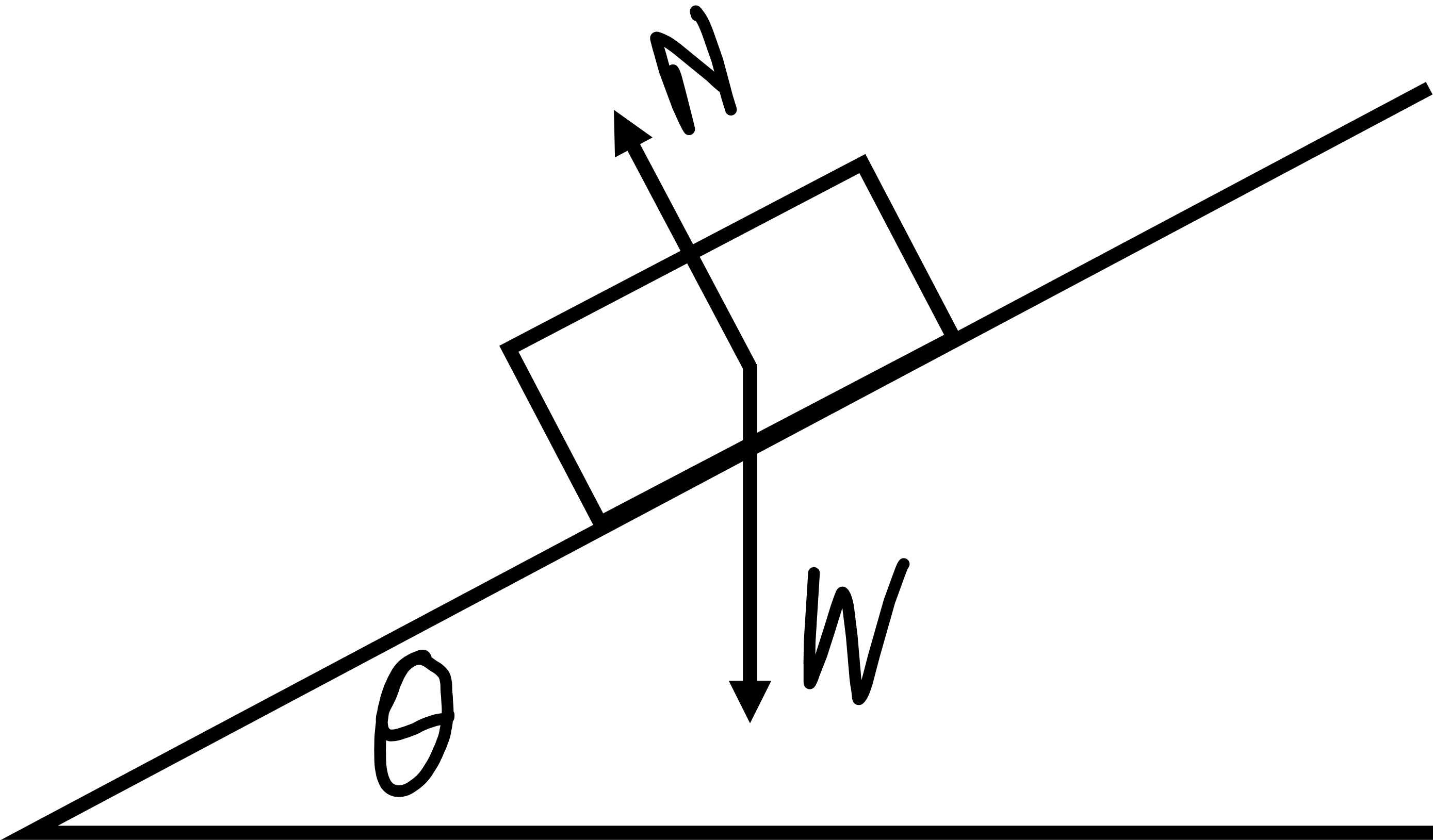
Equation 1 is the Law of conservation of mechanical energy
The law of conservation of mechanical energy states that in a closed system, total mechanical energy is conserved.
Use this equation only when there is no non-conservative force (e.g., friction, applied force, tension, etc.)
Usage of equation 3
Equation 3 is termed the work-energy theorem.
The work-energy theorem states that the net work done on an object by a net force equals the change in kinetic energy of that object.
When you use this equation, please make sure you have drawn the correct free-body diagram. Include all forces that are in the direction of the motion. You can use this equation in all kinds of planes, whether horizontal, vertical and inclined planes.
To resolve the net work, there are two ways to answer the question:
First find the net force acting on the object by adding all the forces acting on it. This is similar to saying, find the individual work terms of all the forces acting on the object.
Usage of equation 4
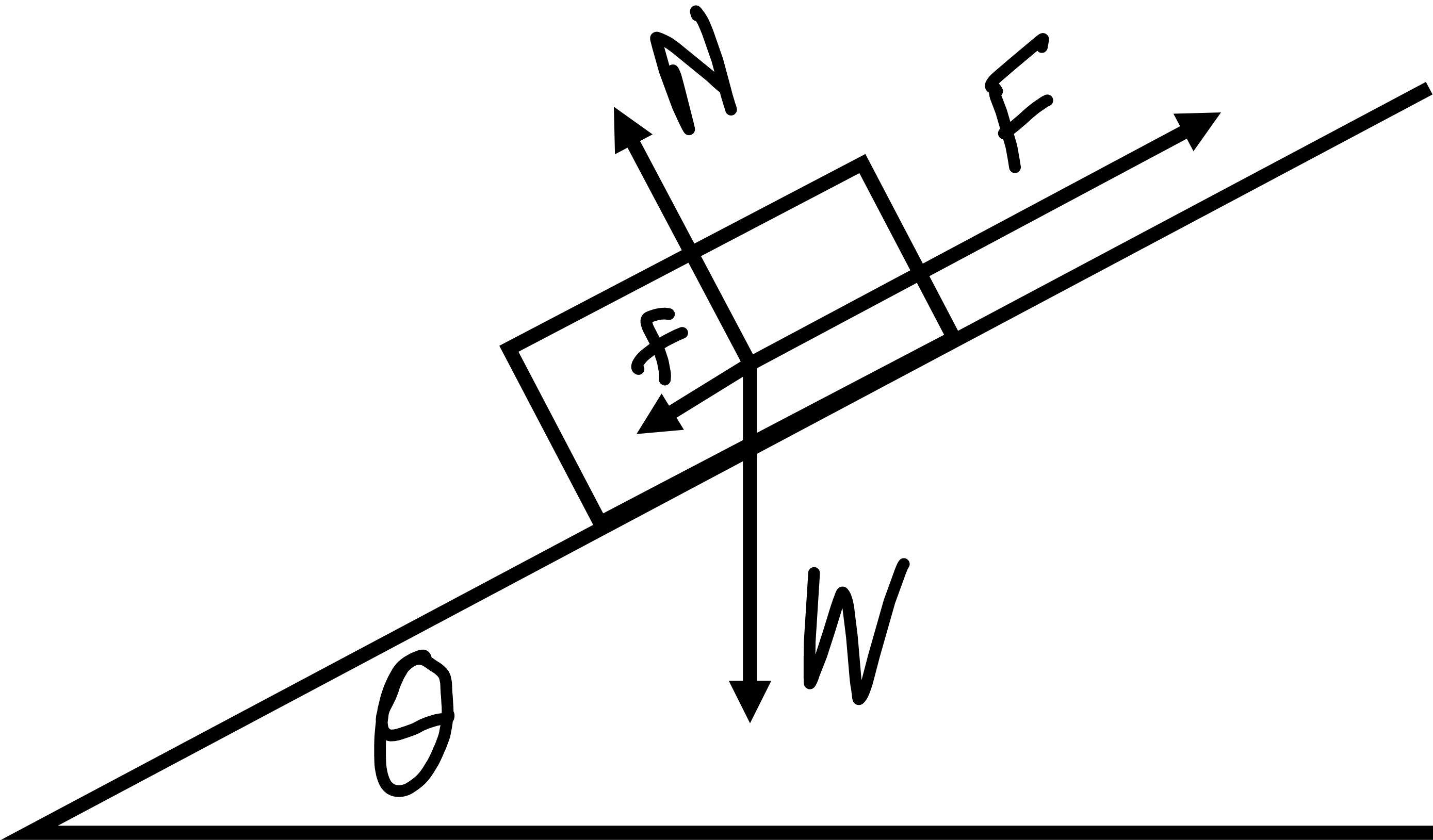
Fig 2 is a free-body diagram of an object going a rough slope with an applied force F and friction, f
Equation 4 is an equation that most students prefer because, like the work-energy theorem, it can be used in all instances, including on inclined planes. However, students lose marks because of the wrong substitution on the \(\normalsize W_{NC}\) part. If you know the definition of a non-conservative force, you can never go wrong with this equation. With the help of a properly drawn free-body diagram like Fig 2, this is easily avoided
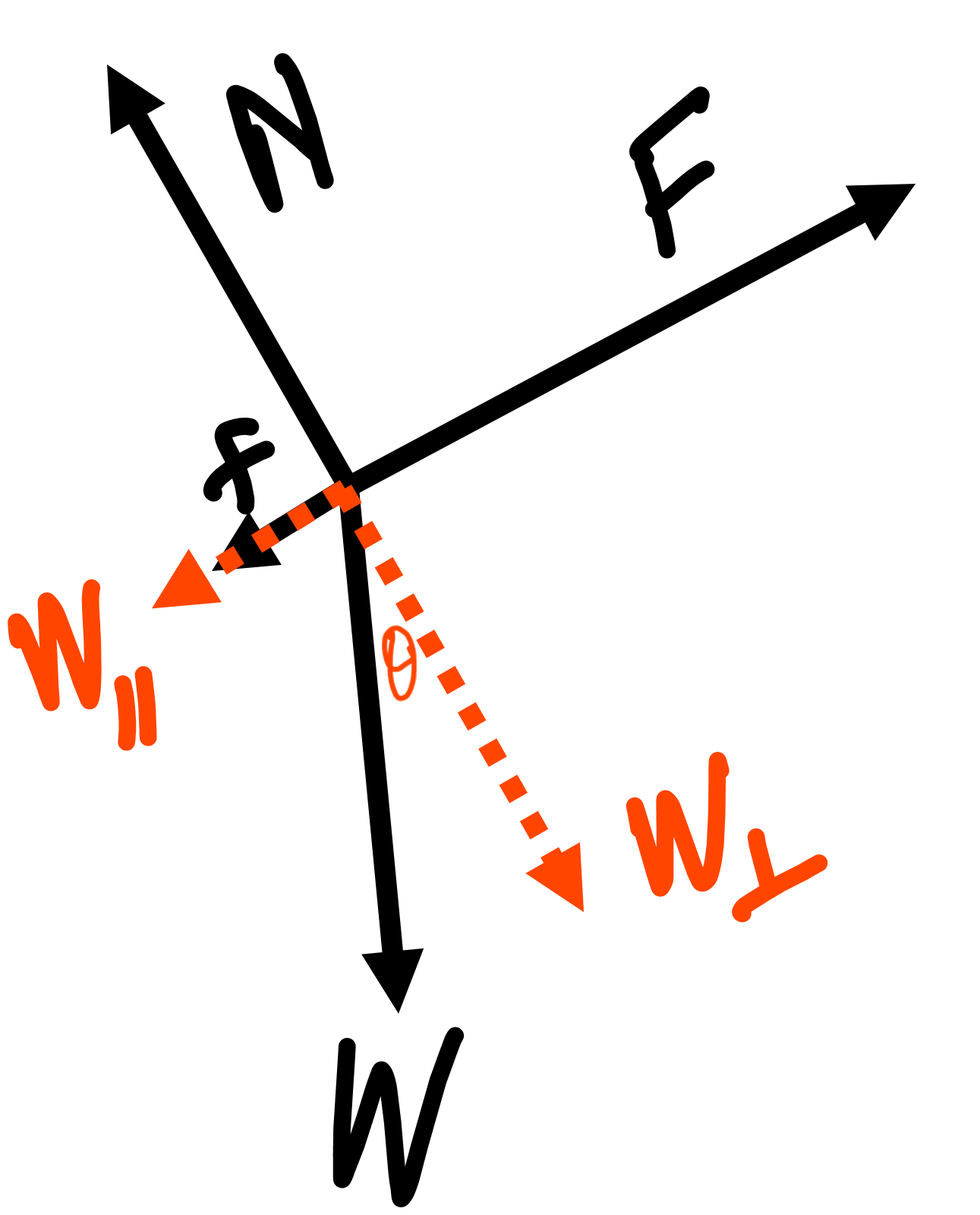
Using the example of the free-body diagram above, Fig 3, the non-conservative forces are the forces, F and f. The \(\normalsize W_{NC}\) will be the work done by these two forces only. Please do not use/include the horizontal component of force of gravity in this equation \(\normalsize W_{//}\) is not a non-conservative force.
In the absence of the non-conservative forces, equation 4 will be reduced to equation 1
We have reached the end of our post. Still don't understand this topic? Click here to get your discount.