NB: The vertical projectile motion being discussed here is in one dimension.
In this post, we will be explaining the projectile motion graphs. There are three kinds of graphs that you will be required to draw and/or interpret in this section:
- Velocity vs. time
- Position vs. time
- Acceleration vs. time graphs
The motion we will be looking at is when the projectile is not bouncing when it lands on the ground/surface.
To be able to understand the graphs that we will show you below, you need to have prior knowledge of functions in grade 10 and 11 mathematics. We relate these functions, especially the linear function and the parabola with the equations of motion:
\begin{alignat} {1} v_f &= v_i +a\Delta{t} \tag{1} \\ v_f^{2} &= v_i^{2} + {2}{a}\Delta{y} \tag{2} \\ \Delta{y} &= v_i\Delta{t} + \frac{1}{2}a\Delta{t^2} \tag{3} \\ \Delta{y} &= (\frac{v_i+v_f}{2})\Delta{t} \tag{4} \\ \end{alignat}As you continue reading, we will show you how these equations are related to the maths functions we mentioned above.
Velocity vs. time graphs.
To plot the graph of velocity vs time, we use the equation:
\begin{gather} v_f=v_i + a\Delta{t}\\ y=c+mx \end{gather}As you can be seen from the equations above, the equation of motion relating velocity to time represents some straight line function. The initial velocity, \(v_i\), represents the y-intercept, \(c\), and the gravitational acceleration, \(a\), represent the gradient \(m\).
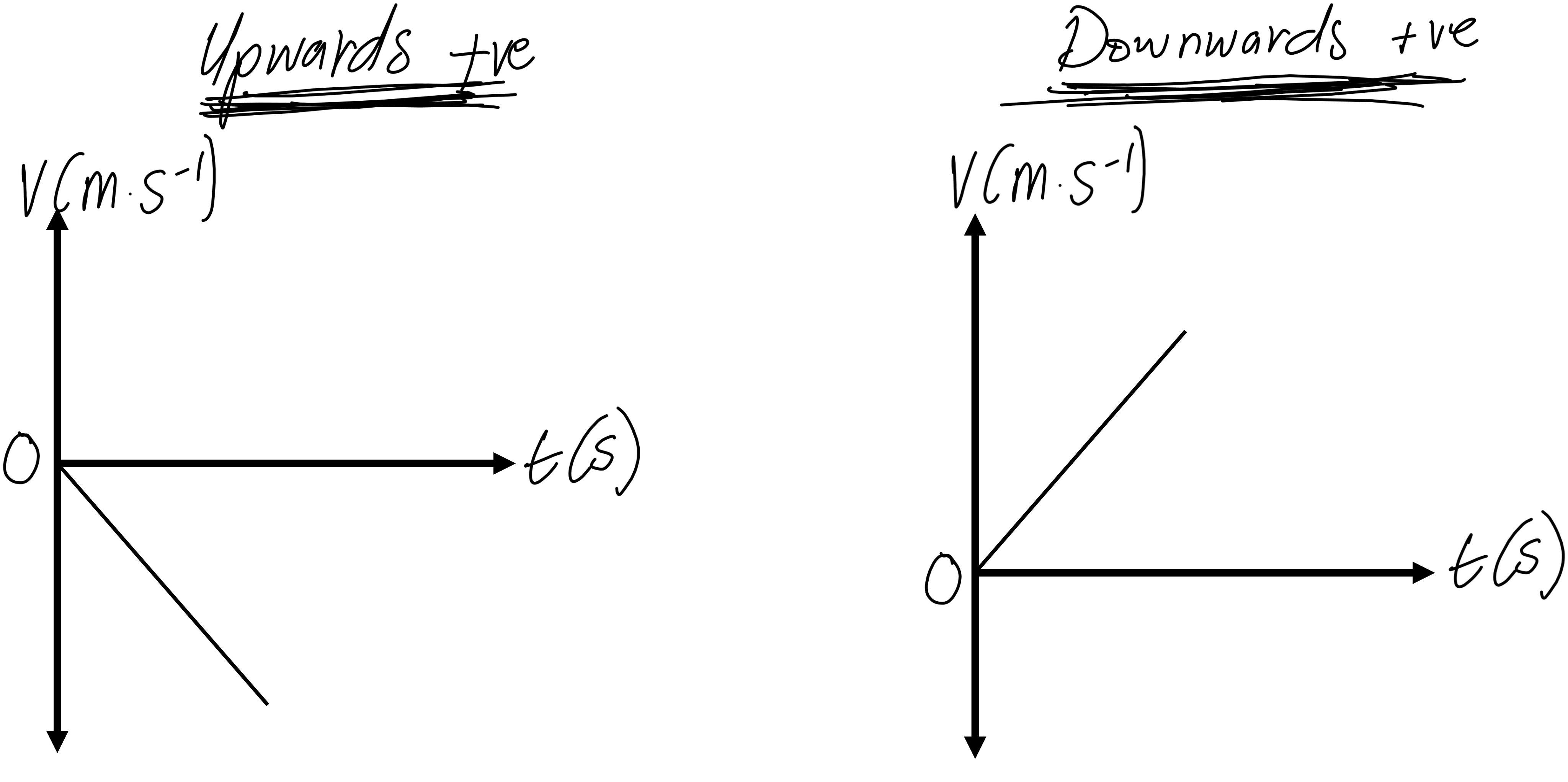
Fig. 1 shows the velocity vs. time graph when the object is dropped. The y-intercept, \(v_i\), on both graphs is zero. When upwards is chosen as positive, we see the graph on the left. This is because the value of gravitational acceleration is \(9.8 \text{ m}\cdot\text{s}^{-1}\). This means the gradient of the line is negative. Doing the same, we can find that when downwards is chosen as positive, the graph on the right will result. When an object is dropped, the initial velocity is zero. We can therefore say, the equation for this motion is:
$$ \normalsize \begin{align} v_f&=v_i+a\Delta{t}\\ v_f &= 0+(-9.8)\Delta{t}\\ v_f &= -9.8\Delta{t} \end{align} $$We can repeat the procedure when downwards is positive.
Let us now see how the graph will look like when a projectile is thrown upwards and returns to point of release.
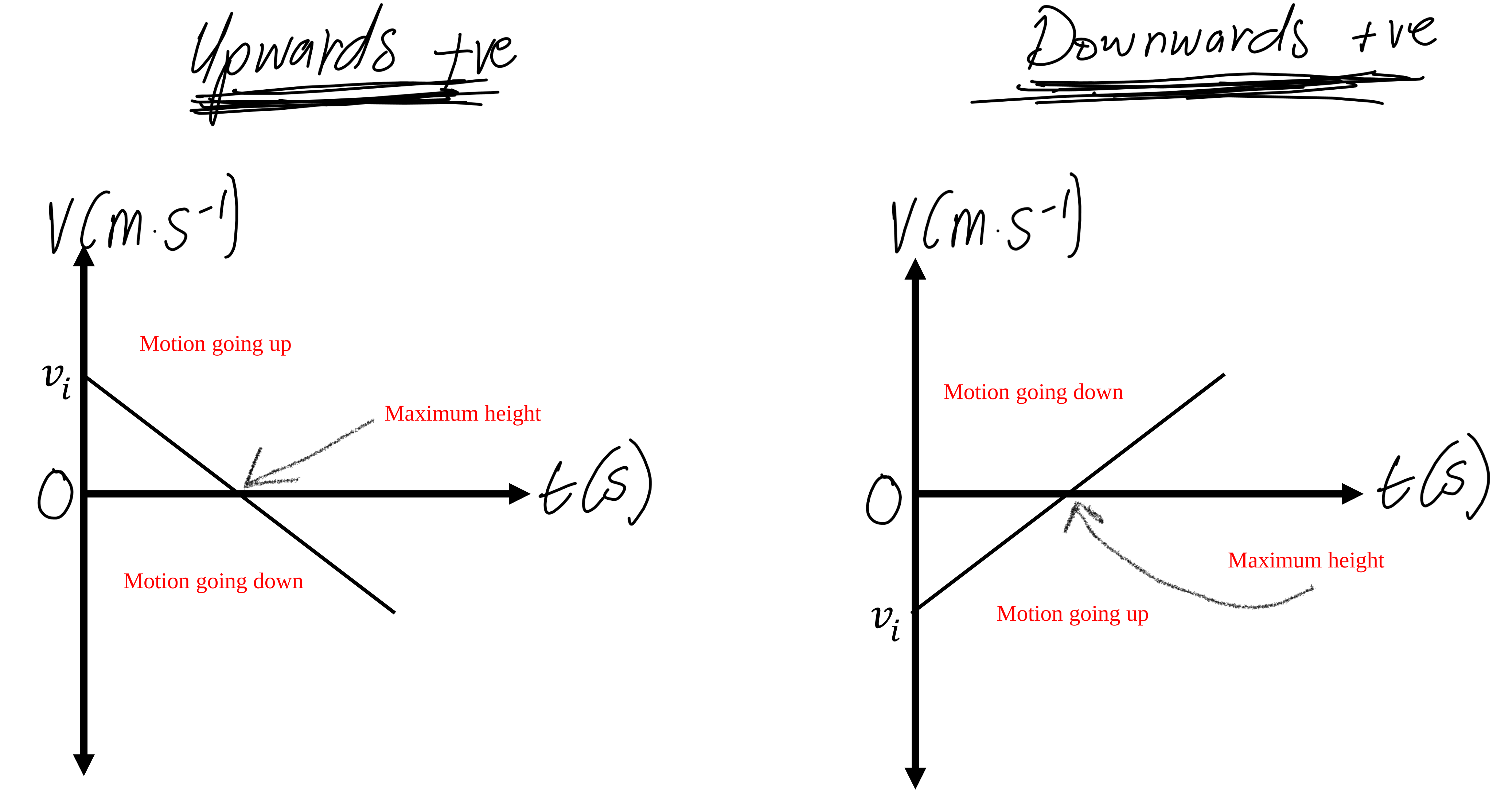
On Fig. 2, the projectile is thrown upwards and returns to the thrower's hand. The initial velocity \(v_i\) is not zero. Unlike in Fig 1, here the graph is in both sides of the time axis. One side will represent motion of the projectile going up while the other will represent the motion going down. The t-intercept (yes, the same as the x-intercept) is the point we refer to as the maximum height. This is where the projectile changes direction. At this point, the velocity is zero.
To draw Fig. 2, we use the same method as in Fig. 1. Using the graph on the left hand side as an example:
$$ \normalsize \begin{align} v_f&=v_i+a\Delta{t}\\ v_f &= v_i+(-9.8)\Delta{t} \end{align} $$NB: the value of \(v_i\) is positive in the above.
Now what happens if the projectile passes the thrower's hand and hits the ground? See Fig. 3.
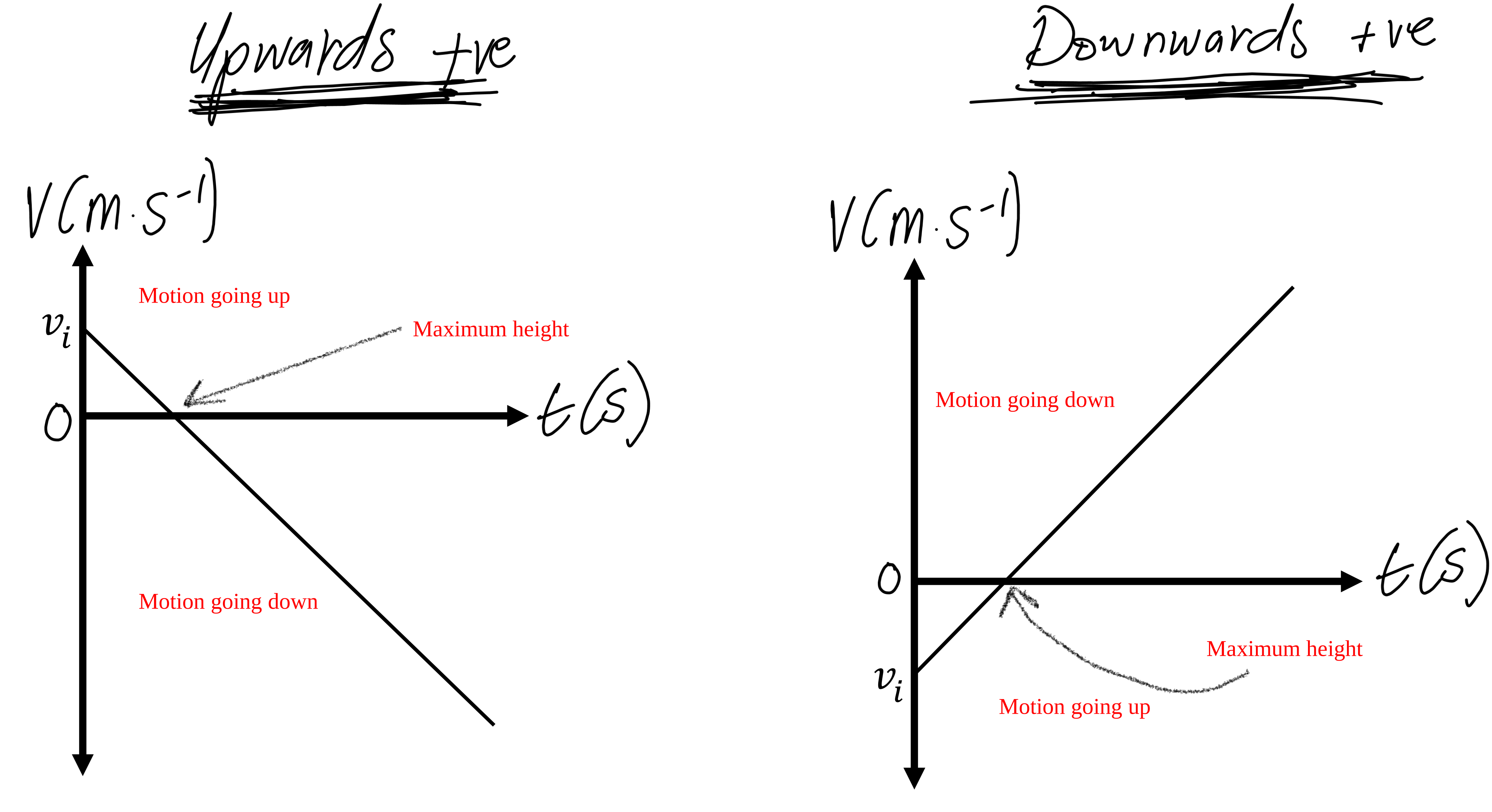
In Fig. 3, the arm that corresponds to the ground(from maximum height ) is longer.This is a situation that will help you see if a projectile returned to the thrower's hand or passed to hit the ground. Pay attention to these details.
Area under the graph.
You will be asked to calculate the area under a curve/graph. Sometimes they even ask you what property does this area represent. The area under a velocity vs time graph represents distance/displacement.
Example: Tiisetso has thrown a ball vertical upwards. Calculate the distance travelled by the ball in 1s. See the graph below
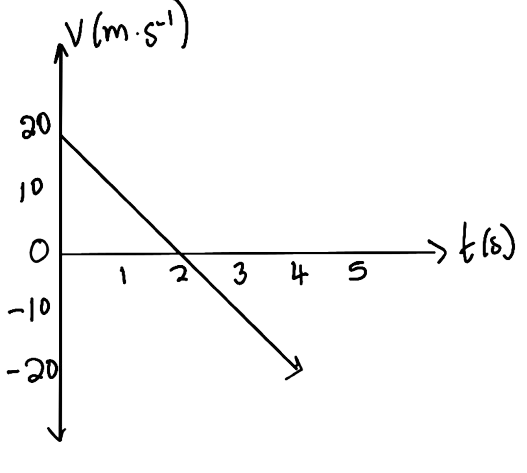
Solution: The area of the graph at t = 1s exhibits a right angled trapezium. We can use use the area of a trapezium or maybe break the area into two parts: from \(\normalsize 0-10 \text{ m}\cdot s^{-1}\) looks like a rectangle and the \(\normalsize 10-20 \text{ m}\cdot s^{-1}\) look like a triangle. Choose whichever you are comfortable with.
Most people don't remember the area of a trapezium, so we will choose the second method.
$$ \normalsize \begin{align*} A&=\frac{1}{2}{b}{h}+lb\\ &=\frac{1}{2}(1)(20-10)+(1)(10-0)\\ &=15m \end{align*} $$Position vs. time graphs
Let's look at the equations of motion that relate position with time. The following equation is the one that can relate position with time.
\begin{align} \Delta{y}&= {v_i}{\Delta{t}}+{\frac{1}{2}}{a}{\Delta{t^2}}\\ y&=bx+ax^2 \end{align}When you look at the equations above, you realise that this is a parabola. However, the y-intercept is zero. The meaning of this is that when you plot a graph, it is assumed that the reference point is the point of release of the projectile. Look at Fig. 5 to understand.
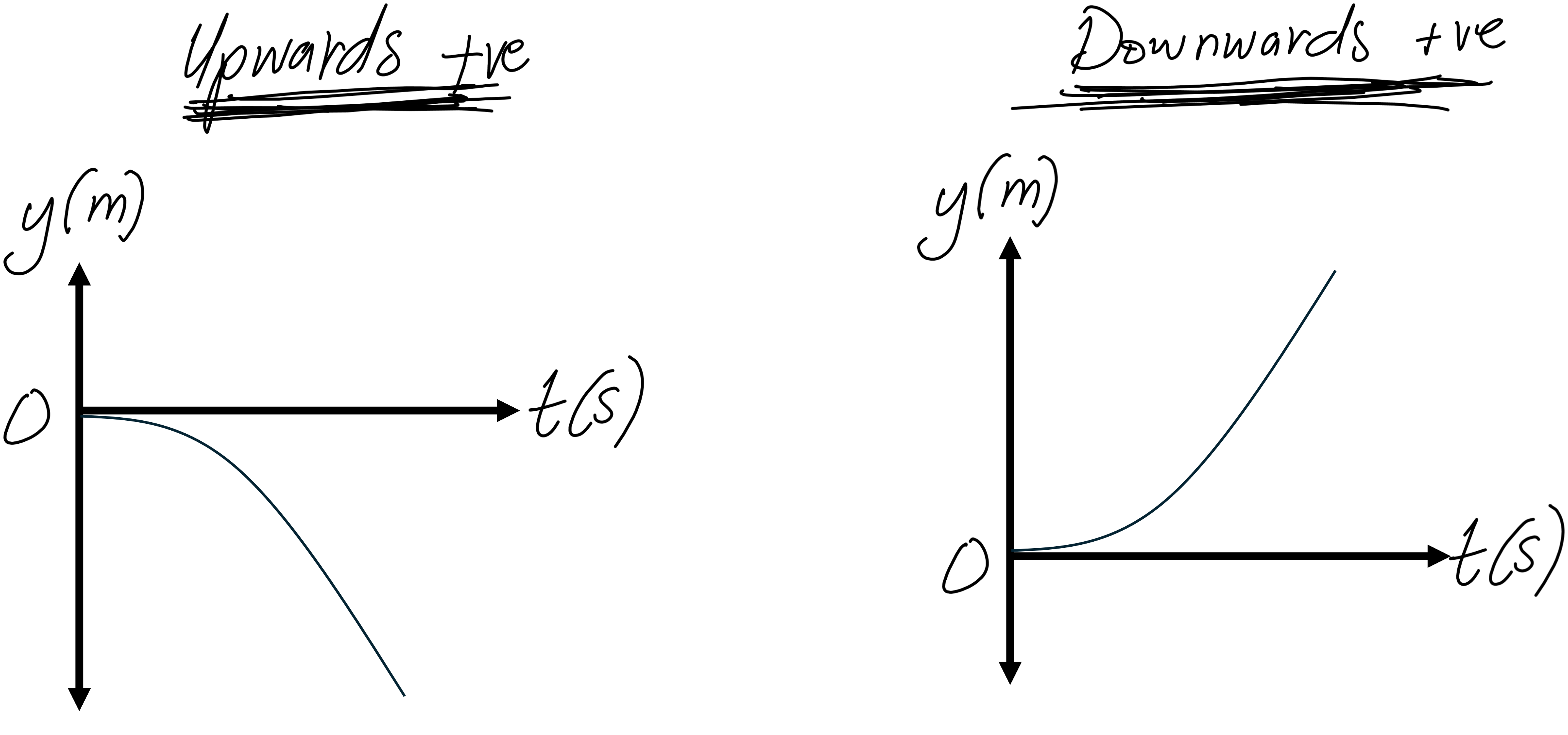
With the position vs. time graphs, you will need to choose a position to want to start your graph from, the reference point. Fig. 5 has chosen the point of release as the reference point.
The graph above starts from \(y=0\). This is the point of release of the projectile. Remember that when the projectile is dropped, its initial velocity is zero. The mathematics of these shape using the figure on the right (downwards is positive):
$$ \normalsize \begin{align} \Delta{y}&= {v_i}{\Delta{t}}+{\frac{1}{2}}{a}{\Delta{t^2}}\\ \Delta{y}&= 0 \times {\Delta{t}}+{\frac{1}{2}}{(\,9.8)\,}{\Delta{t^2}}\\ \Delta{y}&= {4.9}{\Delta{t^2}} \end{align} $$The mathematics above is just to help you understand how these graphs are drawn. They are not for exam purposes.
The position-time graph for when the ground is taken as the reference point is seen in Fig. 6
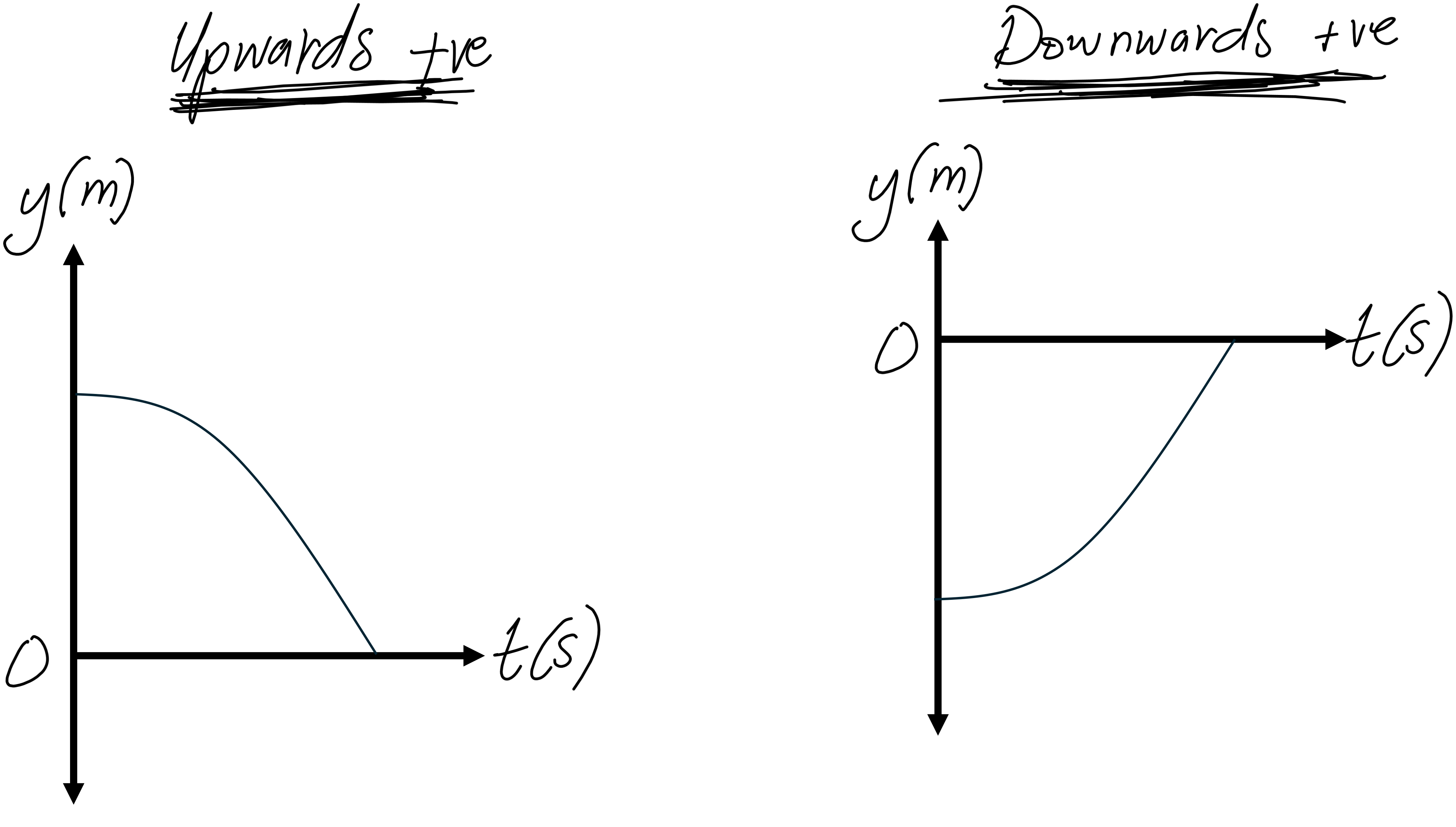
The graph on the left side on Fig 6 is one obtained when upwards is chosen as positive. The gravitational acceleration will be a negative, hence the graph is a frowning quadratic. The y-intercept is positive because initially, the projectile is above the reference point. This is because upwards is positive. The graph on the right can be explained in the same way.
The mathematics for this situation taking, for example, the graph on the left:
$$ \normalsize \begin{align} \Delta{y}&= {v_i}{\Delta{t}}+{\frac{1}{2}}{a}{\Delta{t^2}}\\ y_f-y_i&= {v_i}{\Delta{t}}+{\frac{1}{2}}{a}{\Delta{t^2}}\\ y_f &= y_i + {v_i}{\Delta{t}}+{\frac{1}{2}}{a}{\Delta{t^2}}\\ y_f &= y_i + {v_i}{\Delta{t}}+{\frac{1}{2}}{(\,-9.8)\,}\Delta{t^2}\\ y_f &= y_i + {v_i}{\Delta{t}}-{4.9}{\Delta{t^2}} \end{align} $$Please note that the values of \(y_i\) and \(v_i\) are positive in this case. We chose upwards motion being positive
When the ground is taken as a reference point, the graph on the left will be shifted up with and have a positive y-intercept (\(v_i\)). The graph on the right will be shifted down and have a negative y-intercept (\(v_i\)). For both graphs, the longer arm will stop on the x-axis, the t-axis.
What happens when the projectile is thrown upwards and returns to hit the ground? See Fig, 7
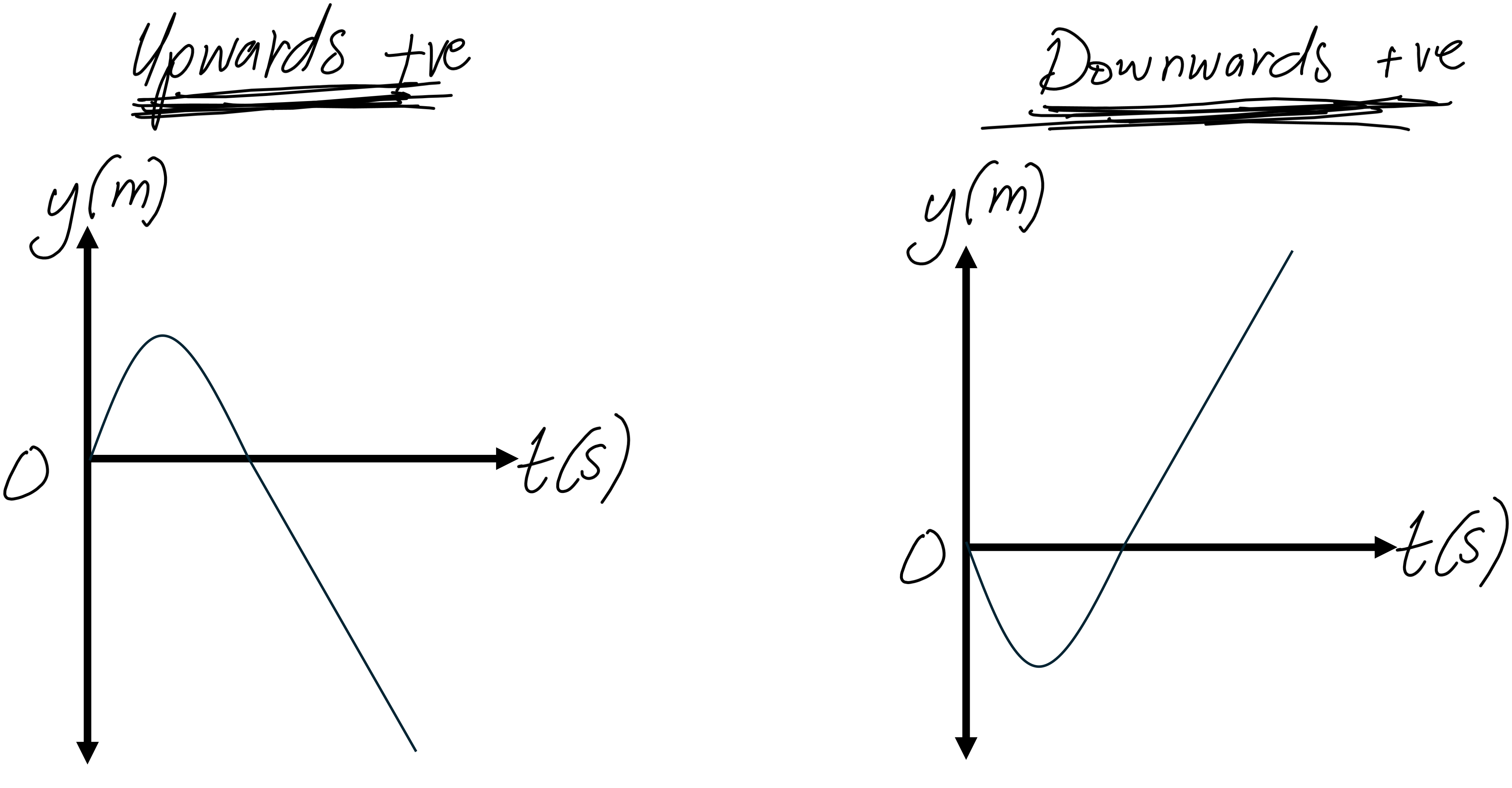
According to Fig. 7, when the projectile is thrown upwards and returns to hit the ground,the arm of the curve on the side of the motion that is towards the ground will become longer.
When the ground is taken as a reference point, the graph on the left will be shifted up with and have a positive y-intercept (\(v_i\)). The graph on the right will be shifted down and have a negative y-intercept (\(v_i\)). For both graphs, the longer arm will stop on the x-axis, the t-axis.
Acceleration vs. time
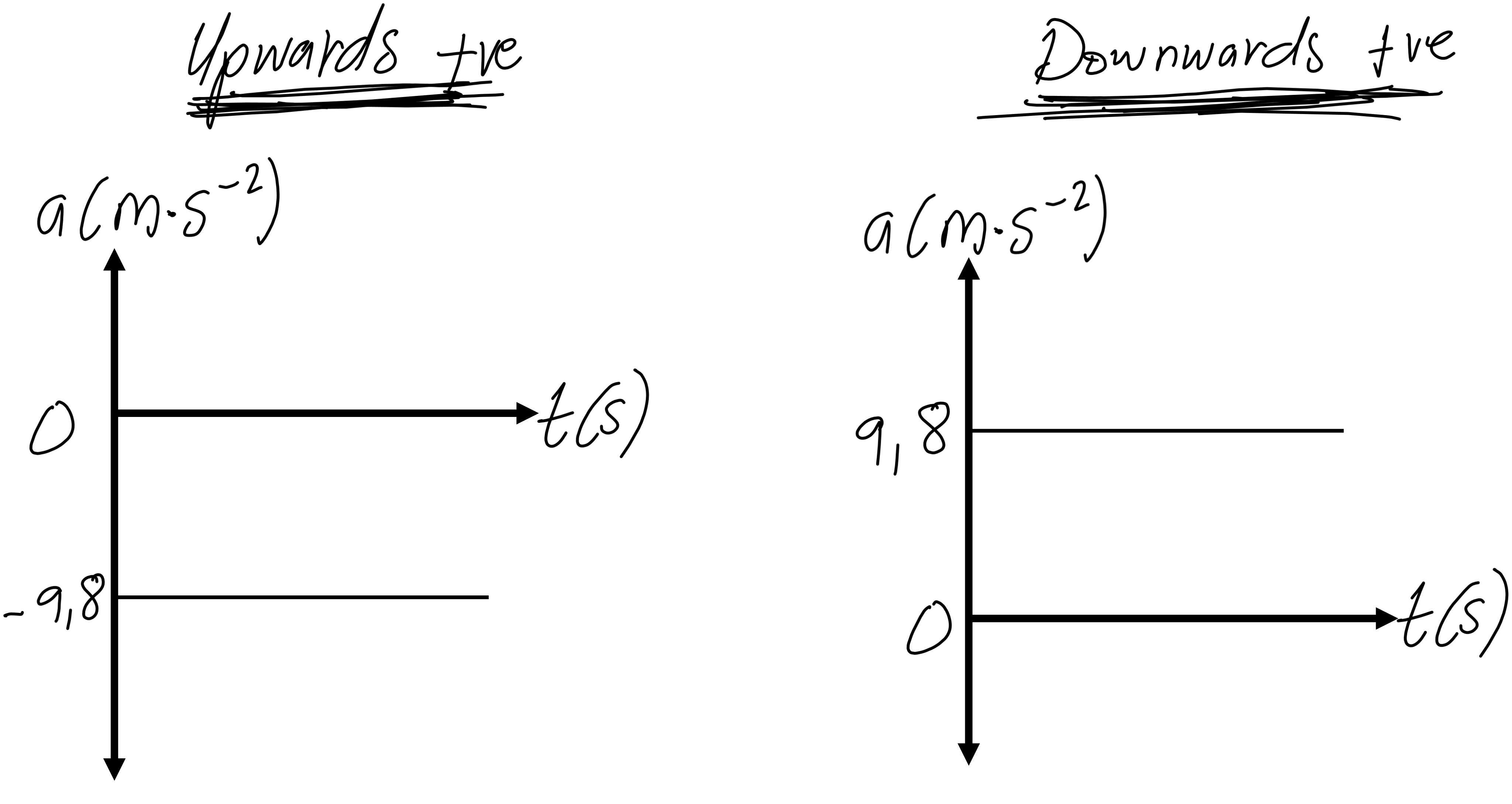
In vertical projectile motion, objects/projectiles are in free fall. The only force that is affecting them is the force of gravity and therefore, the gravitational acceleration will remain constant. We therefore expect the graph to be some constant line. See Fig. 8 below.