


Transformation geometry involves making images or copies of an object.
Grade 4 mathematics syllabus introduced you to transformation geometry which involved tessellations. In grade 5 you were then introduced to translation, reflection, dilation and rotation. The grade 9 mathematics concluded this topic by completing all the rules involved in transformation geometry.
These notes or concept, you will use until grade 12. At that time, you will only be asked about these processes in the exams and they will never be covered again in class. My child, know them by heart.
Now that you are in grade 9, transformation geometry will be about creating an image of a shape by performing the above processes. As you get to higher grades, you will apply these processes to functions/graphs.
The general rule or notation for transformation geometry is that a new point is called an image, symbolised with an apostrophe (') next to the name of a point, i.e,:
$${A \rightarrow A'}$$1. Translation
When you translate objects/functions, you are moving them to a new point. Translations move objects either horizontally or vertically. Translation is also known as shifting.
The general rule for translation is:
$${(x;y) \rightarrow (x+a;y+b)}$$Where \(a\) and \(b\) are parameters that are for horizontal and vertical shifting, respectively. They represent the amounts of translation: positive for rightwards and upwards and negative for leftwards and downwards.
Horizontal translation
Horizontal translation moves objects leftwards or rightwards. The general rule:
$${(x;y) \rightarrow (x+a;y)}$$Remember: \(a\) is positive when an object is moved to the right and negative when moved to the right.
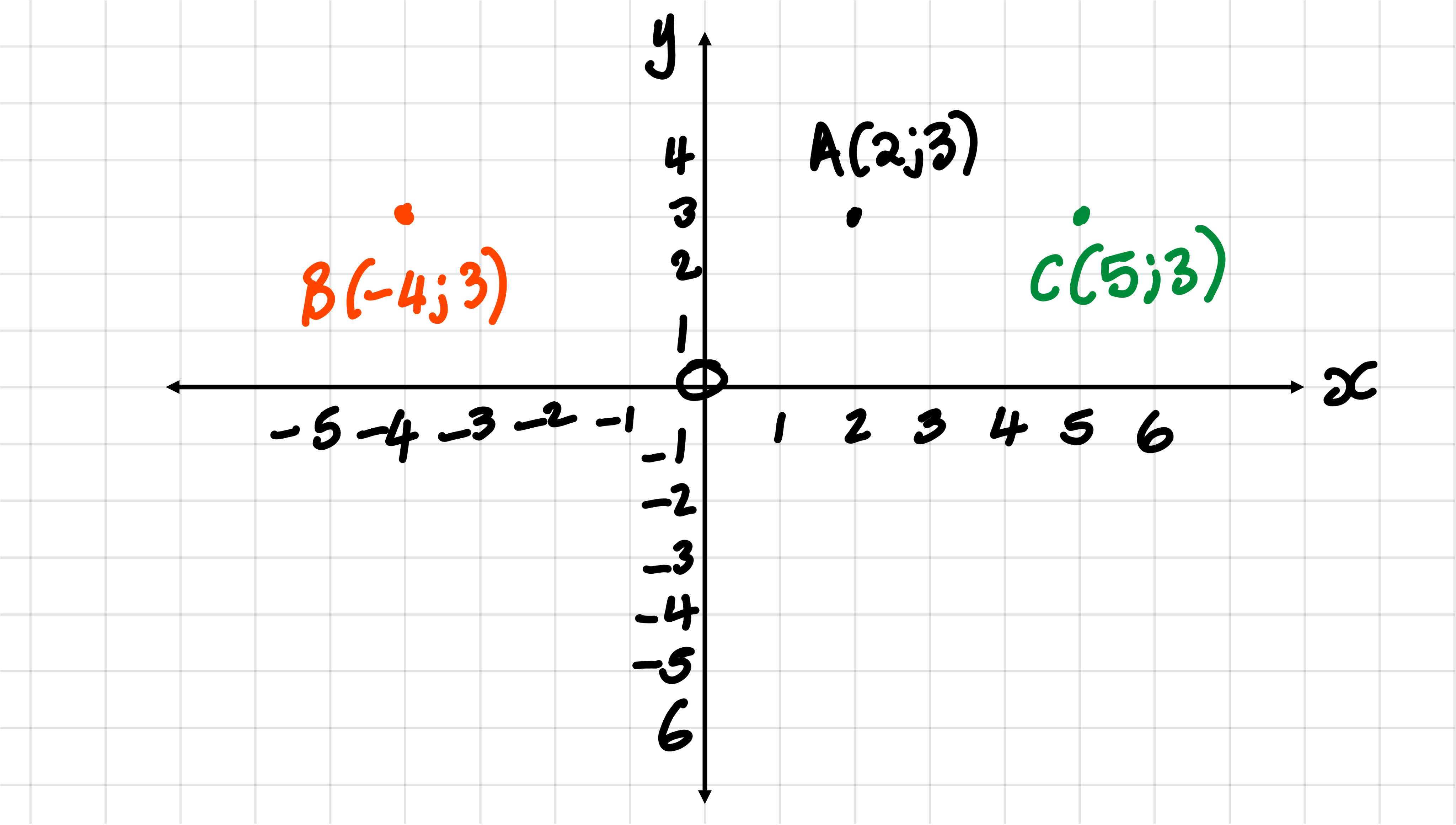
Example: Move point A(2;3)
- 6 units left. Call the new point B.
The new point will be:
\begin{align*} (2;3) &\rightarrow B(2-6;3)\\ (2;3) &\rightarrow B(-4;3) \end{align*}The new point is B(-4;3)
- 3 units to the right. Call the new point C.
The new point will be:
\begin{align*} A(2;3) &\rightarrow C(2+3;3)\\ A(2;3) &\rightarrow C(5;3) \end{align*}The new point is C(5;3)
The sketch below shows the results of the above example. In a graph, the results can be obtained simply by moving according to number stated for the translation. For example, a shift of 6 units to the left means that you should count six numbers to the left of your point.
Vertical translation
For the vertical translation, the function will either move up or down. The general rule:
$${(x;y) \rightarrow (x;y+b)}$$Remember: \(b\) is positive when an object is moved up and negative when moved down.
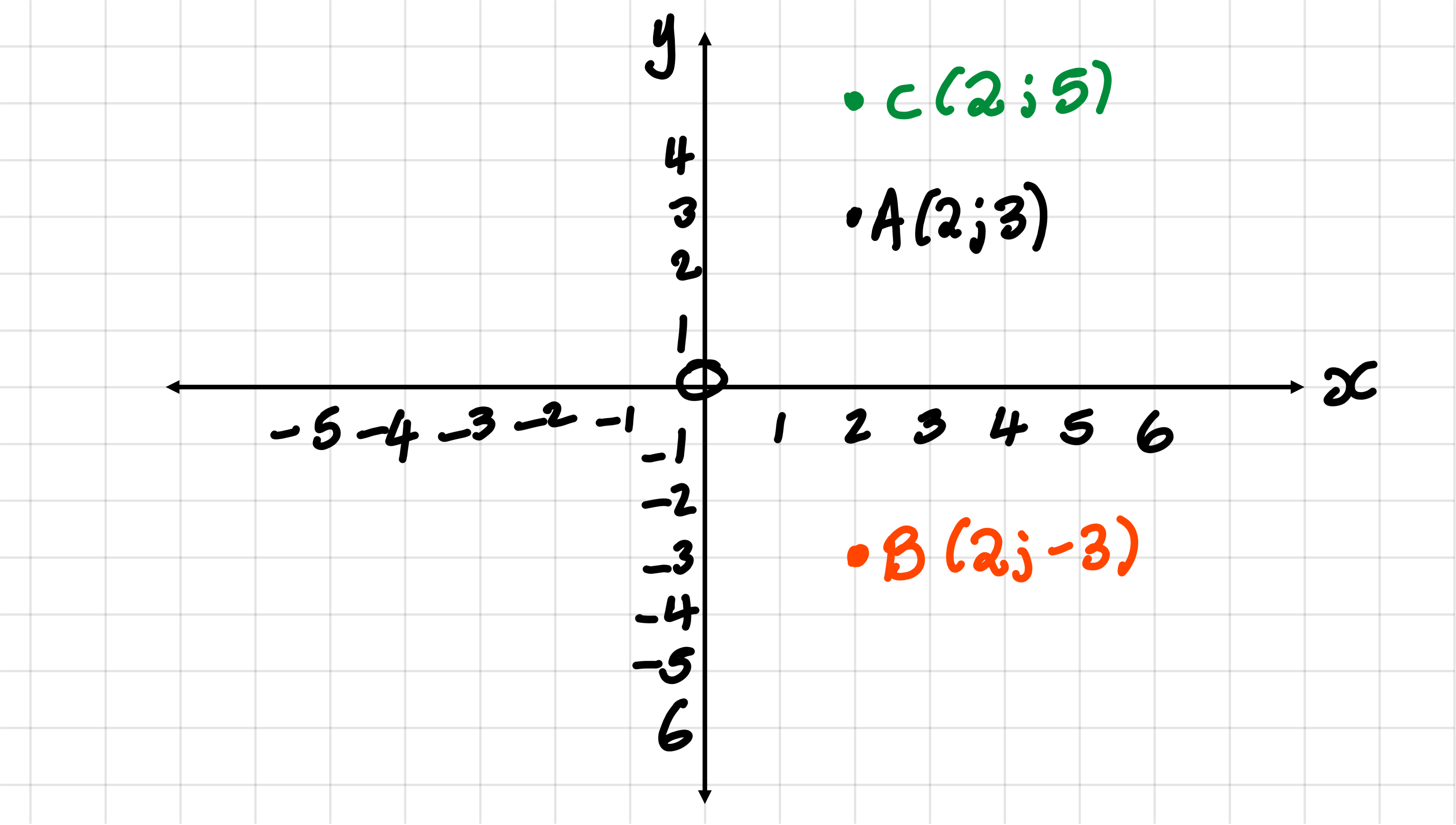
Example: Move point A(2;3)
- 6 units down. Call the new point B.
The new point will be:
\begin{align*} A(2;3) &\rightarrow B(2;3-6)\\ A(2;3) &\rightarrow B(2;-3) \end{align*}The new point is B(2;-3)
- 2 units up. Call the new point C.
The new point will be:
\begin{align*} A(2;3) &\rightarrow C(2;3+2)\\ A(2;3) &\rightarrow C(2;5) \end{align*}The new point is C(2;5)
2. Reflection
In this transformation, an object will be reflected across a line, creating an image. In reflection transformations, distance between the original point and the reflecting line is the same as the distance from the image and the reflecting line.
The reflecting line is the symmetrical line between the original point and the image.
We can say, if the reflection is correct, midpoint of these points must be a point lying on the reflecting line.
Reflection on the \(x\)-axis
When reflecting in the \(x\)-axis, the \(x\)-values remain constant while the \(y\)-values change the sign.
The transformation rule is:
$${(x;y) \rightarrow (x;-y)}$$Here the reflecting line is the \(x\)-axis.
Example: Reflect A(2;3) on the \(x\)-axis
$${A(2;3) \rightarrow A'(2;-3)}$$The new point is A'(2;-3). As we can see from this result, the new point is in the opposite side of the \(x\)-axis, the negative \(y\)-values side.
Reflection in the y-axis
When reflecting in the y-axis, the y-values remain constant while the x-values change the sign.
The transformation rule is:
$${(x;y) \rightarrow (-x;y)}$$Here the reflecting line is the \(y\)-axis.
Example: Reflect A(2;3) on the \(y\)-axis
$${A(2;3) \rightarrow A'(-2;3)}$$The new point is A'(-2;3). As we can see from this result, the new point is in the opposite side of the \(y\)-axis, the negative \(x\)-values side.
Reflection in the horizontal line \(y = k\)
In this reflection on the horizontal line \(y = k\), reflection can be made on any other horizontal line , other than the \(x\)-axis, where \(k\) is the value of the \(y\) where the reflection is made.
Same idea exists here - the distance between the original point and the reflecting line must be the same as the one between the image and the reflecting point.
The rule for this transformation:
$${\normalsize (x;y) \rightarrow (x;2k-y) \text{, }k\in\mathbb{R}}$$Reflecting line is the line, \(y=k\). NB: \(x\)-value does not change.
On this rule, the \(k\) is the value of the reflecting line
Example: Reflect A(2;3) on the line \(y=1\)
Solution: The reflecting line is \(y=1\). Therefore, the value of \(k=1\)
$$ \normalsize \begin{align*} 2k-y &= 2(1)-3\\ &= -1 \end{align*} $$The image is:
$${A(2;3)\rightarrow A'(2;-1)}$$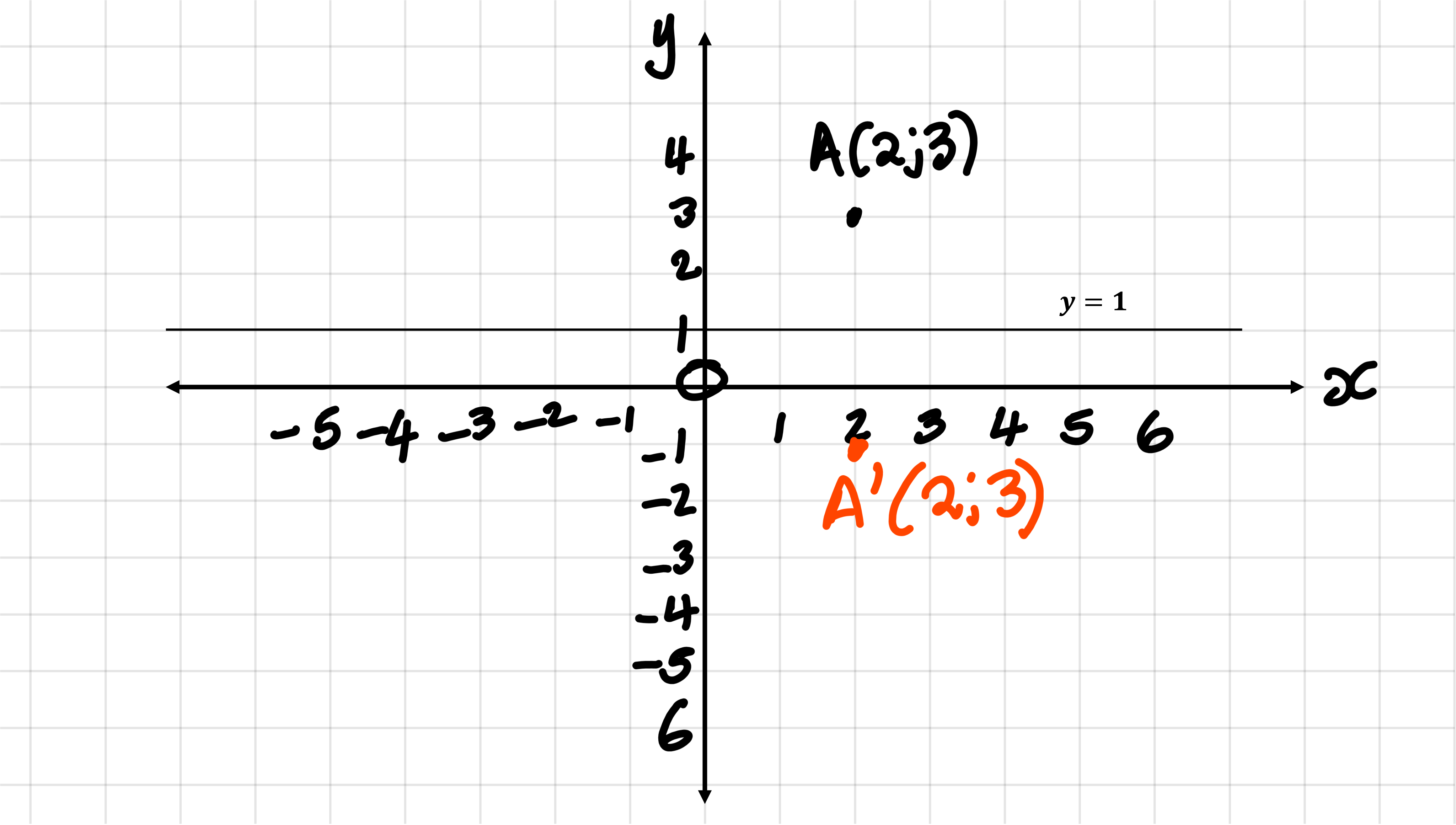
In the figure above, we can see that the distance between the original point and the reflecting line is the same as the distance between the reflecting line and the image.
Reflection in the vertical line \(x = k\)
In this reflection on the vertical line \(x = k\), reflection can be made on any other vertical line, other than the \(y\)-axis, where \(k\) is the value of the \(x\) where the reflection is made.
The rule for this transformation:
$${\normalsize (x;y) \rightarrow (2k-x;y) \text{, }k\in\mathbb{R}}$$Reflecting line is the line, \(x=k\). NB: \(y\)-value does not change.
Example: Reflect A(2;3) on the line \(x=-1\)
Solution: The reflecting line is \(x=-1\). Therefore, the value of \(k=-1\)
$$ \normalsize \begin{align*} 2k-x &= 2(-1)-2\\ &= -4 \end{align*} $$The image is:
$${A(2;3)\rightarrow A'(-4;3)}$$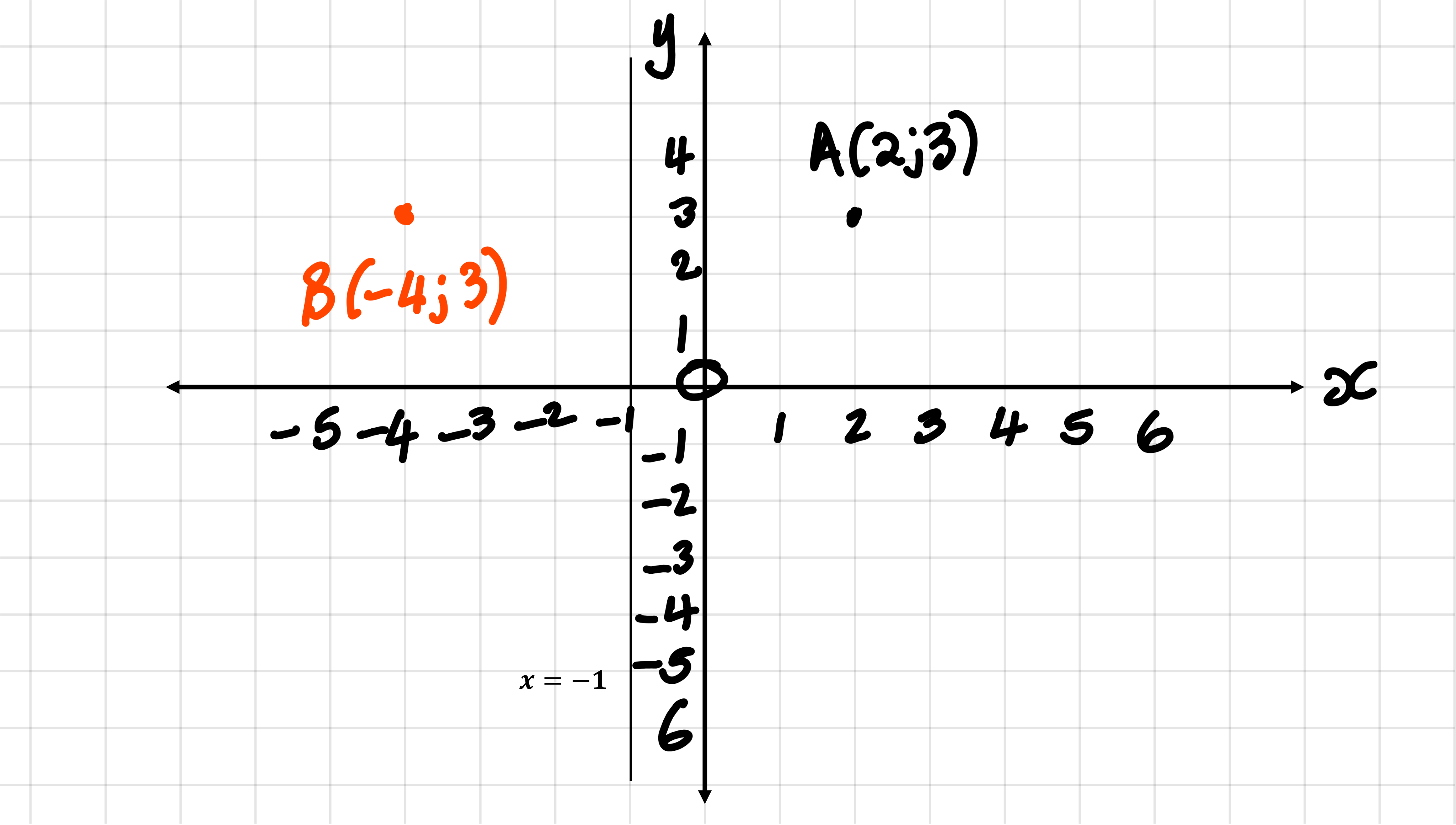
In the figure above, we can see that the distance between the original point and the reflecting line is the same as the distance between the reflecting line and the image.
Reflection in the line \(y = x\)
Reflection in the line \(y = x\), simply requires you to swap the values. What was the x-value will now become the y-value and what was the y-value will now become the x-value.
The transformation rule is:
$${(x;y) \rightarrow (y;x)}$$Here the reflecting line is the \(y=x\).
Example: Reflect A(2;3) on the \(x\)-axis
$${A(2;3) \rightarrow A'(3;2)}$$Reflection in the line \(y = -x\)
This reflection is thought of being the same as \(y=x\). This is partially true.
We have to rearrange the equation to make \(x\) subject of the formula, so \(x=-y\). The new point is \(A'(-y;-x)\). Yes, we have swapped the values around, not ignoring the sign. So indeed this is the same as the technique for reflecting on \(y=x\)
The rule:
$${(x;y) \rightarrow (-y;-x)}$$Here the reflecting line is the \(y=-x\).
Example: Reflect A(2;3) on the line \(y=-x\).
$${A(2;3) \rightarrow A'(-3;-2)}$$Reflection in the line \(y = mx+c\)
There are two methods used to reflect on a straight line,\(y = mx+c\). The first method involves solving the equation, \(y = mx+c\) for \(x\) and for \(y\). This method only works for equations with gradients of 1 and \(-1\). For other gradients, we use the method below:
- Find the equation of the line perpendicular to the one given in the question.
- Find the point of intersection of the two lines. The point is the midpoint of the original point and the image.
- Use the midpoint and the given point to find the image. The equation of the midpoint. $${\normalsize M=( \frac{x_1+x_2}{2};\frac{y_1+y_2}{2} )}$$
Let us try two examples to show these methods.
Example: Gradients of \(1\) or \(-1\)
Reflect \(A(2;3)\) on the line \(y=-x-1\).
Solutions: The line/equation we are using is \(y=-x-1\). It is already in terms of \(x\). We will now rearrange it to put it in terms of \(y\).
$$ \normalsize \begin{align} y &= -x-1\\ x &= -y-1 \end{align} $$The image will be \(A'(-y-1;-x-1)\)
$$ \normalsize \begin{align} &A(2;3):\\ &y = -2-1=-3\\ & x = -3-1=-4\\ &\therefore A'(-4;-3) \end{align} $$This method only works when the gradient of the line is 1 or -1.
Remember we said when a reflection is correct, the distances between the reflecting lin and the points with be equal? See the figure below which is the information of this question.
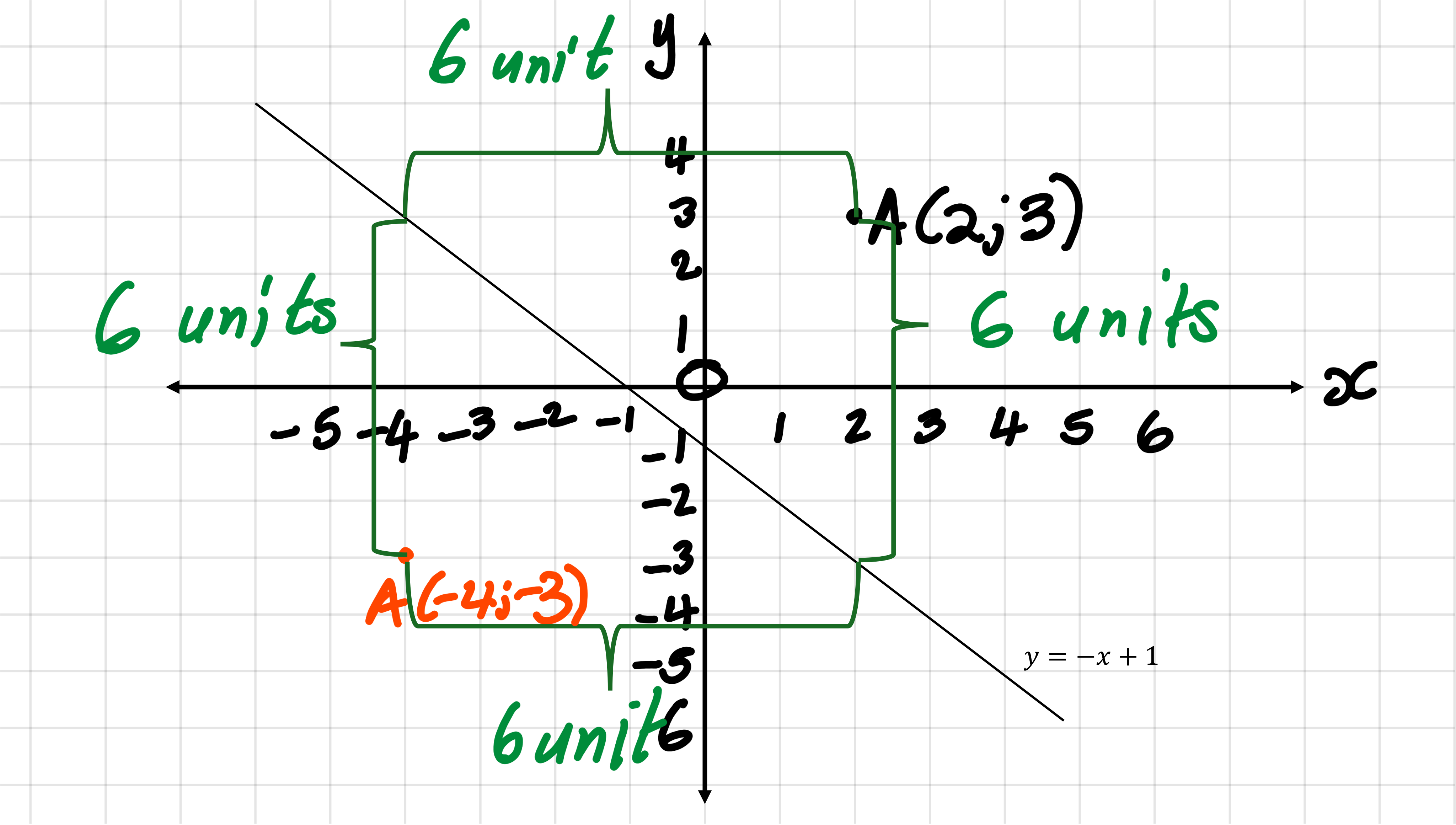
You can prove if this is correct by finding the midpoint of the A and A'. If you do, you will realise the midpoint of these points is \((-1;0)\). This is the point on the line. Therefore, the values are correct.
Example: Gradients other than \(1\) and \(-1\)
Reflect A(2;3) on the line \(y=2x+3\).
Solution: We will use the above method.
The line perpendicular to \(\displaystyle y=2x+3\) will have the gradient, \(\displaystyle m=-\frac{1}{2}\).
Equation of the perpendicular line:
Midpoint (point of intersection of the two lines):
$$ \normalsize \begin{align*} 2x+3 &= -\frac{1}{2}x+4\\ 4x+6 &= -x+8\\ 5x &= 2\\ x &= \frac{2}{5}\\ y &= \frac{19}{5}\\ \end{align*} $$The midpoint is \((\displaystyle \frac{2}{5};\frac{19}{5})\)
Finding the image using the midpoint.
$$ \normalsize \begin{align*} \frac{2}{5} &= \frac{x_1+x_2}{2}\\ \frac{2}{5} &= \frac{2+x_2}{2}\\ 4 &= 10+5x\\ -6 &= 5x\\ x &= -\frac{6}{5}\\ \end{align*} $$Now finding the \(y\)-value:
$$ \normalsize \begin{align*} \frac{19}{5} &= \frac{y_1+y_2}{2}\\ \frac{19}{5} &= \frac{3+y_2}{2}\\ 38 &= 15+5y\\ 38 &= 5y\\ y &= \frac{23}{5}\\ \end{align*} $$The image \(\displaystyle A'(-\frac{6}{5};\frac{23}{5})\)
3. Dilation
Dilation is about changing the size of the object either by enlarging or shrinking by a factor.
The transformation rule is:
$${(x;y) \rightarrow (kx;ky)}$$Where \(k\) is a dilation factor.
- Enlargement: \(k\) is a natural number.
- Shrinking: \(k\) is a decimal number (a fraction).
4. Rotation
We will explain rotation by summarising the methods or rules in the table below:
If you are using a small screen, please rotate your screen to have a better view of the table below!!
| Process | Rule | Example |
|---|---|---|
| Rotation 90° clockwise | (x;y) → (y;-x) | (2;3) → (3;-2) |
| Rotation 90° anticlockwise | (x;y) → (-y;x) | (2;3) → (-3;2) |
| Rotation 180° | (x;y) → (-x;-y) | (2;3) → (-2;-3) |
| Rotation 360° | (x;y) → (x;y) | (2;3) → (2;3) |
From the table above, we can summarise that:
- 90° rotation: x and y-values interchange.
- 180° rotation: x and y-values remain the same but have opposite signs.
- 360° rotation: x and y-values remain the same.